FOR IMMEDIATE RELEASE: April 10, 2025
Contact: Will Spisak, will@neweconomyc.org
In Face of Spiraling Affordability Crisis and Looming Federal Disinvestment, NYC Groups and Electeds Demand Bold Action to Advance Community Control of Land and Housing
Broad Coalition Seeks Passage of the Community Land Act & Funding for Community Land Trusts and Deeply Affordable Housing
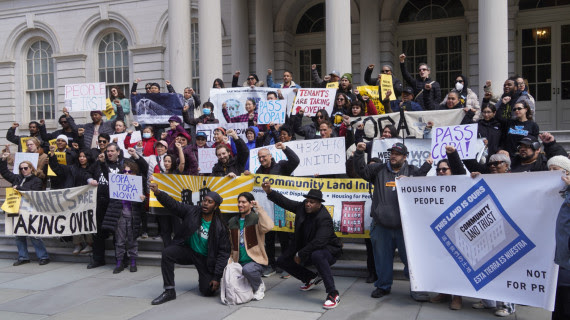
New York, NY – As homelessness and displacement continue to skyrocket and federal disinvestment threatens to further exacerbate the affordability crisis, over 50 NYC community groups and elected officials rallied at City Hall on Thursday to demand the City Council pass urgently needed legislation that would remove land and housing from the speculative market and bring it into permanently affordable community ownership.
The groups demanded passage of the Community Land Act, a slate of City Council bills backed by 150+ groups that would enable community land trusts (CLTs) and other nonprofits to dramatically expand the supply of deeply and permanently affordable housing in low-income and Black and brown neighborhoods.
CLTs are community-controlled nonprofit organizations that steward land for the public good; in New York City, about 20 CLTs are working to combat displacement, develop and preserve deeply affordable housing, and advance neighborhood-led development.
The groups also called for $3 million in the city budget to support CLT organizing and technical assistance, and capital funding dedicated to helping CLTs acquire and rehabilitate more multifamily buildings and other property.
The rally comes amid a deepening affordability crisis in New York City, where an estimated 350,000 people lived in shelters, on the streets, or doubled up in the homes of others as of January 2025. One third of non-migrant shelter residents are employed yet still unable to afford the city’s soaring housing costs. At the same time, looming federal funding cuts to the Department of Housing and Urban Development (HUD) and other agencies threaten to make the crisis even worse.
In an effort to “Trump-Proof” the city budget, the NYC Council has already called on Mayor Adams to increase funding for housing and NYCHA in the FY 2026 budget. Today, rally-goers urged the Council to ensure housing and development funds are prioritized for CLTs and other community-based nonprofit partners, which have a proven track record of creating more deeply affordable housing than private, for-profit developers.
The Community Land Act legislative package includes the Community Opportunity to Purchase Act (COPA), which would give CLTs and other mission-driven nonprofits a first right to purchase multifamily buildings when landlords sell; the Public Land for Public Good Act, which would require the city to prioritize CLTs and other nonprofits in public land dispositions; and Resolution 374, which calls on New York State to enact the Tenant Opportunity to Purchase Act.
At the rally, CLT organizers and tenants described recent victories to take land and housing away from neglectful and predatory landlords and bring properties into community control, and they explained how the CLA would help CLTs take this work to scale.
QUOTES:
“Community land trusts (CLTs) are organizing across the city to fight displacement and address root causes of our city’s deepening affordability crisis,” said Deyanira Del Rio, Executive Director of the New Economy Project, which co-founded and coordinates the NYC Community Land Initiative. “Federal disinvestment threatens to exacerbate the crisis and fuel new waves of real estate speculation. It’s time for the City Council to pass the Community Land Act — to help CLTs and other mission-bound nonprofits expand the supply of deeply-affordable, community-controlled housing New Yorkers desperately need.”
“As the Trump administration sows chaos through the federal government, New York City must act now to pass housing policies that promote community ownership and long-term affordability,” said Council Member Carlina Rivera, lead sponsor of the Community Opportunity to Purchase Act (COPA). “Staffing and funding cuts threaten programs that keep hundreds of thousands of New Yorkers safely housed, and elected leaders have a responsibility to insulate our city from the negative impacts that could exacerbate displacement pressures and instability. I remain committed to securing investments for capital, infrastructure, public housing, tenant protections, and more to create opportunity and stronger neighborhoods.”
“We have an affordability crisis in our City,” said Council Member Lincoln Restler, lead sponsor of Public Land for Public Good. “Far too many city-owned lots have been misused to develop housing that is unaffordable to local residents. As rents continue to rise and more and more New Yorkers are struggling to get by, we need to act now on a new vision for housing in our City that maximizes truly affordable housing on every public lot.”
“Community land trusts are a time-tested and effective model that brings housing and land into democratic, community control,” said Council Member Sandy Nurse. “Passing the Community Land Act will better equip our communities to prevent displacement, preserve and grow deeply affordable and social housing, and preserve green spaces in environmental justice communities like mine. With compounding Federal housing cuts, we need to pass the Community Land Act to ensure working class folks can stay and thrive in New York.”
“In Southeast Queens, we’re seeing homes bought and flipped at alarming rates, pricing out the very families who built our communities,” said Council Member Dr. Nantasha Williams. “The Community Land Act and increased funding for community land trusts are essential tools to protect our neighborhoods from speculation and displacement. At a time when federal support is uncertain, New York City must take bold action to ensure land and housing remain permanently affordable and under community control. Constituents deserve stability, not speculation.”
“63 Tiffany Place tenants are facing potential eviction due to the expiration of their Low-Income Housing Tax Credit agreement and their greedy landlord. Their situation is a perfect example for why we need to pass TOPA in Albany and COPA in the City Council,” said Council Member Shahana Hanif. “For these tenants, these bills could mean the difference between staying in their homes and being priced out of New York City entirely. I am grateful to all of the residents, organizations, and CLTs who are fighting to get these bills passed.”
“We saw recently, with 2201-2205 Davidson Ave in the Bronx, how it is possible to put property in the People’s hands. We need to do it on a much larger scale. Let’s make sure that we pass all of this legislation,” said Council Member Crystal Hudson.
“As we continue to face a housing and homelessness crisis, we must commit to building and preserving affordable housing for those who need it most,” said Will Depoo, Senior Campaign Organizer at the Association for Neighborhood and Housing Development. “The package of bills in the Community Land Act provides our communities with more tools to fight speculation, develop responsibly, move distressed buildings into the hands of responsible community stewards, and ensure that public resources go where they’re most needed.”
“The Community Land Act is key to determining how the City develops and evolves,” said Arif Ullah, of South Bronx Unite and the Mott Haven-Port Morris Community Land Stewards. “In essence, it’s a reflection of the City’s values. The question is, are our legislators, our Mayor, our Council Speaker equally committed to a just and equitable city that prioritizes the well-being of the vast majority of its residents, or is their allegiance to the real estate industry and private interests? Whether they support and champion the CLA is the answer.”
“It’s outrageous that the city has not met the basic demand that our public assets — city-owned land — be used for public good, for permanently affordable housing. We must pass the Public Land for Public Good Act,” said Brianna Soleyn, a board member of the East New York Community Land Trust. “And we must pass COPA. The ENY CLT put in the work to organize residents and donors to directly purchase our first building, which was neglected by its former owner. Through COPA, the city can support acquisitions like these, of over-leveraged rent stabilized housing stock, to ensure that these buildings are kept affordable and under tenant control. These acquisitions are proven to work and directly improve New Yorkers’ lives.”
“This Land Is Ours CLT is working on several new construction projects, and all will be deeply affordable,” said Valerio Orselli, Project Director of This Land Is Ours CLT. “On the East 5th St. NYPD Parking Lot, we plan to develop upwards of one hundred apartments for seniors and disabled people. The site has been designated for low-income housing, and we have secured over 600 signatures in support of our project from our Lower East Side community as well as the overwhelming support of Community Board 3. The City plans to issue an RFP open to all developers, and we would like them to prioritize disposition to a CLT. Far too much public land has been turned over to for-profit developers. We must pass the Community Land Act now.”
“CLTs all over New York City are showing that they have the momentum and the know-how to take land off the speculative market and put people over profit,” said Alexis Foote, Founder and Board Chair of ReAL Edgemere Community Land Trust. “Let’s pass the Community Land Act to give CLTs the tools they need to turn neighbors into owners. Generational wealth has been stolen from communities of color through land, and CLTs will be the catalyst for reparations.”
“New Yorkers are being kicked out of their homes, poisoned by toxic industries, and losing opportunities to pass on their homes and their communities to their children, simply because our neighborhoods are seen as a way to make profit instead of as a public good,” said Cameron Clarke, campaign coordinator at WE ACT for Environmental Justice. “At a time of unprecedented uncertainty, we need City Hall to move with urgency on the Community Land Act and make sure that we are building healthy, stable communities right here in New York City.”
“Having lived in the same apartment in Hell’s Kitchen for more than forty years and having witnessed firsthand the devastating effects the action and inaction of a predatory landlord has had on my fellow tenants and neighbors, I believe it is high time for the city to pass the Community Land Act,” said Nicholas Latimer, Tenants’ Association leader at 438/440 W. 45th Street, apartment buildings formerly owned by Daniel Ohebshalom, a NYC ‘worst landlord’ as declared by the NYC Public Advocate’s Office. “The care and maintenance of our homes should be entrusted to the people to whom it matters the most: the residents of our community.”
“Every year, hundreds of thousands of violations of housing law are issued in NYC while millions of renters are severely rent-burdened,” said Mark Natanawan, Tenant Organizer at Housing Conservation Coordinators. “We need to fix up run-down apartment buildings across the city and tackle the affordability crisis by investing in and supporting community-owned, nonprofit-operated housing. Now, more than ever, our city needs to step up and pass the Community Land Act!”
“The NWBCCC and Bronx CLT are already beginning to demonstrate the power of community-driven development to provide deeply and permanently affordable housing through our new construction and preservation projects,” said Todd Baker, Community Development Project Manager at Northwest Bronx Community & Clergy Coalition (NWBCCC). “The Community Land Act would provide the policy framework necessary to scale projects like these across the Bronx and beyond. This is the kind of transformative approach that our neighbors need and deserve.”
“Land is a precious resource, and it is unacceptable that publicly owned land is sold to developers for as low as $1 in a city facing a serious housing crisis,” said Annetta Seecharran, Executive Director of Chhaya Community Development Corporation. “The Community Land Act will ensure that it falls in the hands of community centered groups like CLTs, CDCs and nonprofits who have long been fighting against gentrification, foreclosures and homelessness. The time to act is now.”
“TakeRoot calls for the immediate passage of the Community Land Act,” said Paula Z. Segal, Senior Staff Attorney in the TakeRoot Justice Equitable Neighborhoods unit. “COPA will level the playing field for tenants and the community-based organizations when properties hit the market; TOPA will give tenants the right to buy their own buildings. A new system to collect on property tax debts will protect low-income homeowners and tenants by ensuring that the City is engaging when owners fall behind in their payments and is seeking equitable solutions, including foreclosing on slumlords when appropriate. The Community Land Act strikes a balance between tenant power and property rights, pointing to a City that generations of working-class New Yorkers will be able to call home.”
“NYC is facing a critical shortage of deeply affordable housing, and we continue to lose affordable units to ongoing rent hikes and landlord warehousing,” said Jenny Dubnau, Co-Chair of the Western Queens CLT. “Gentrification and displacement are hollowing out Black and immigrant communities, and largely unaffordable housing is being built even on publicly owned land, often by for-profit developers. For example, a city-owned site on Hunters Point South in Queens is now being offered to developers, at only 60% affordability — and the proposed AMI levels are still too high. Mission-driven non-profits and CLTs can provide far deeper affordability than for-profit developers: our city leaders must pass the Public Land for Public Good Act to ensure deep, permanent affordability on public land. The Public Land for Public Good Act, part of the CLA, could also help WQCLT obtain a large city-owned manufacturing building on the gentrifying Queens waterfront, offering affordable work and cultural spaces to those who are currently priced out. And the CLA could help us obtain and fund additional sites for deeply affordable housing: we need the Community Land Act to pass!”
“Chinatown has one of the lowest rates of home ownership in all of New York City, and no new affordable units have been built in the last 30 years,” said Jacky Wong, Coordinator of the Chinatown Community Land Trust. “This systemic neglect has long-term social and economic ramifications for our neighborhood, with extreme fire hazards being just one of them. These problems are driving our neighborhood’s rapid decline, and it is time for a change. The CLT funding would enable the community to explore practical and sustainable solutions. It’s high time for our voices to be heard, and for the city to take action to uplift and improve our community for generations to come.”
“Cooper Square Committee fully supports the Community Land Act and calls on New York City to pass it this year,” said Illapa Sairitupac, a Housing Organizer at Cooper Square Committee. “Our organization frequently works with tenants whose lives are upended when their building is sold to a neglectful corporate landlord. TOPA and COPA will give tenants the ability to facilitate needed improvements and preserve the affordability of their buildings in perpetuity. Such policies have already proven successful in places like Washington, D.C., and it’s high time New York brought them here. Now with federal cuts to affordable housing, we need the CLA to pass more than ever.”
“TOPA would let residents like us stay in our homes and keep our neighborhoods from becoming playgrounds for the wealthy. The tenants in this city are at a disadvantage, fighting against millionaires, billionaires, and increasingly, private equity. It’s a David vs. Goliath fight. Let’s pass the Community Land Act in the City Council and TOPA in the State Legislature to level the playing field,” said John Leyva, a tenant leader at 63 Tiffany Place.
###