Contact: Will Spisak, New Economy Project, will@neweconomynyc.org
Council Holds Historic Hearing on Social Housing Package as NYC’s Housing Crisis Hits Breaking Point
Advocates Demand Passage of Community Land Act to Bring Land and Housing into Permanently Affordable Community Control
Ahead of Hearing, Coalition Hosts “Social Housing Festival” and Speak-Out, Calls on Speaker Adams and Council to Dedicate $3 Million to the Community Land Trust Initiative
New York, NY – On Tuesday, the NYC Council held a historic hearing to consider multiple broadly supported social housing bills that would remove land and housing from the speculative market and bring them into permanently affordable, democratic community control.
New Yorkers from the NYC Community Land Initiative coalition and allied groups packed Council Chambers to testify and wave hand-made fans emblazoned with messages calling on Speaker Adrienne Adams and the City Council to pass the Community Land Act. This bold social housing package would enable community land trusts (CLTs) and other nonprofits to dramatically expand deeply and permanently affordable housing in low-income and Black and brown neighborhoods. CLTs are community-governed nonprofits that own land and steward it for the public good.
The hearing came as housing insecurity reaches crisis levels across the city. More than half of Black and Latino households, and nearly half of Asian households, now face homelessness, unaffordable rents, unsafe conditions, or the threat of displacement, according to the state comptroller.
The Community Land Act legislative package includes:
- The Community Opportunity to Purchase Act (Intro 902), which would give CLTs and other mission-driven nonprofits a first right to purchase multifamily buildings when landlords sell
- Public Land for Public Good (Intro 78), which would require the city to prioritize CLTs and other nonprofits in public land dispositions
- Resolution 374, which calls on New York State to enact the Tenant Opportunity to Purchase Act.
At the hearing, the New York City Department of Housing Preservation and Development (HPD) testified and faced questions on the Community Land Act. After years of advocacy by New Economy Project and coalition partners, HPD moved off its hardline stance on COPA, signaling openness to a version of the policy. This marks a meaningful breakthrough that advocates see as a sign that the legislation’s passage is firmly within reach.
The groups also called on the City Council to increase funding for the Citywide CLT Initiative, now in its sixth year, by allocating $3 million in the upcoming budget for CLT organizing and technical assistance. They also urged the City to dedicate capital funding to help CLTs acquire and rehabilitate more multifamily buildings and other property.
The groups further urged the City to abolish the predatory Tax Lien Sale and replace it with an equitable program administered by a land bank to transform tax distressed properties into permanently affordable, community- and tenant-owned housing. They also called for legislation empowering City agencies to work with CLTs that steward not only housing but also community and commercial spaces and other vital land uses.
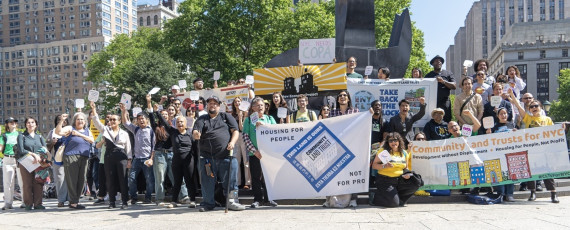
Ahead of the hearing, supporters of the Community Land Act – including elected officials and over 150 community, housing, and environmental justice groups – held a Social Housing Festival and Speak-Out in Foley Square. The event highlighted the tremendous growth in the city’s community land trust (CLT) movement, from two CLTs a decade ago to more than 20 CLTs now stewarding affordable housing, community and commercial hubs, green spaces, and more in every borough.
The festival featured performances by the Radical Evolution Street Theater Troupe and the DSA choir, along with art-making, housing resources, and calls to action.
QUOTES:
“With rents skyrocketing and displacement rampant, New Yorkers are calling for a bold solution: housing that’s permanently affordable and under community control,” said Deyanira Del Rio, Executive Director of New Economy Project, which coordinates the NYC Community Land Initiative coalition. “It’s time for the City Council to pass the Community Land Act — to help CLTs and other nonprofits expand the supply of deeply-affordable, community-controlled housing New Yorkers desperately need.”
“Amidst a housing crisis that threatens to displace long-time residents, we must use every tool at our disposal to secure permanently affordable, dignified housing for New Yorkers,” said NYC Council Member Pierina Sanchez, Chair of the Committee on Housing and Buildings. “The Community Land Act represents a paradigm shift, where trusted community partners like community land trusts and non-profit developers — in collaboration with tenants — are positioned to address housing needs that the private market cannot solve. With this legislative package, we can level the playing field and create innovative solutions that make housing accessible and center people over profit. I look forward to today’s hearing and welcome an additional rehabilitation pathway for our aging housing stock that will empower our communities and provide long-term housing stability.”
“New York City is in a persistent housing affordability crisis, demanding urgent, people-centered solutions. The Community Land Act offers a meaningful path forward for community ownership and long-term affordability,” said Council Member Carlina Rivera, lead sponsor of the Community Opportunity to Purchase Act (COPA). “With policies like the Community Opportunity to Purchase Act, we can help trusted community organizations and land trusts secure, preserve, and develop the affordable housing stock that working families, older adults, and long-time residents rely on. I remain committed to securing investments for capital, infrastructure, public housing, tenant protections, and more to create opportunity and stronger neighborhoods.”
“Young families in New York City are struggling to get by—rent, groceries, and childcare costs just keep rising,” said Council Member Lincoln Restler, lead sponsor of Public Land for Public Good. “We have the power to maximize redevelopment of public land into truly affordable housing by putting it in the hands of non-profit developers.”
“Social housing is a successful international model that New York City has yet to fully embrace. The Community Land Act and other bills we’re hearing today will bring us closer to realizing a more robust social housing sector, one that prioritizes people over profit, democracy over landlordism, and sustainability over extraction,” said Council Member Sandy Nurse. “There is a reason why cities with healthy social housing sectors have such high quality of life, and it’s time we catch up.”
“In Southeast Queens, we’re seeing homes bought and flipped at alarming rates, pricing out the very families who built our communities,” said Council Member Dr. Nantasha Williams. “The Community Land Act and increased funding for community land trusts are essential tools to protect our neighborhoods from speculation and displacement. At a time when federal support is uncertain, New York City must take bold action to ensure land and housing remain permanently affordable and under community control. Constituents deserve stability, not speculation.”
“63 Tiffany Place tenants are facing potential eviction due to the expiration of their Low-Income Housing Tax Credit agreement and their greedy landlord. Their situation is a perfect example for why we need to pass TOPA in Albany and COPA in the City Council,” said Council Member Shahana Hanif. “For these tenants, these bills could mean the difference between staying in their homes and being priced out of New York City entirely. I am grateful to all of the residents, organizations, and CLTs who are fighting to get these bills passed.”
“There is an undeniable housing crisis in our city—one characterized by a severe lack of affordability and the active displacement of our older Black and brown neighbors who have resided in New York City for generations. Passing the Community Land Act and establishing a network of Community Land Trusts to create deeply and permanently affordable housing that low and moderate income New Yorkers can afford is critical at this juncture,” said Council Member Crystal Hudson. “We saw recently, with a property in the Bronx, how it is possible to put private property in the people’s hands. With the Community Land Act, we have an opportunity to do just that on a much larger scale. I’m thankful to Council Members Rivera and Restler for leading on this issue, and am proud to stand with them to protect New York families from housing insecurity.”
“I’m proud to stand with New Economy Project and all the advocates fighting to make social housing a reality in New York,” said Council Member Christopher Marte. “We are in the middle of a deep affordability crisis, and our current housing strategy—relying on tax breaks for private developers—has failed to deliver for working-class New Yorkers. The Social Housing Development Authority legislation, introduced by Assembly Member Gallagher and Senator Cleare, is a visionary plan to turn that around. By creating a self-financing public authority focused on building permanently affordable housing—not profits—we can invest in union jobs, sustainable buildings, and tenant power. Moreover, Public Land for Public Good, which I co-sponsor, will ensure public land is used for permanently-affordable housing and other public benefits. Both Resolution 777 and Intro 78 send a clear message: New York City is ready to move beyond luxury towers and toward a housing system rooted in equity, permanence, and community control.”
“The Community Land Act isn’t just about policy—it’s about who this city is for. The Community Land Act would help make sure public land is used for public good, not handed over to private developers. That’s the kind of change we need,” said Matthew Shore, Senior Organizer at South Bronx Unite. “In the South Bronx, the Mott Haven-Port Morris Community Land Stewards turned a nearly 23,000 square-foot, city-owned building into the HEArts Center—a community-managed hub for holistic health and wellness, education, and the arts, which will open in 2027 in a neighborhood that currently lacks accessible community spaces. That’s what it looks like when public land serves the people. So, the real question is: will our Mayor, our City Council Speaker, and our elected leaders stand with communities fighting for this equity-centered bill that would be a game changer in development as we know it? Their decision on advancing the Community Land Act this year will make that clear.”
“It’s outrageous that the city has not met the basic demand that our public assets — city-owned land — be used for public good, for permanently affordable housing. We must pass the Public Land for Public Good Act,” said Brianna Soleyn, a board member of the East New York Community Land Trust. “And we must pass COPA. The ENY CLT put in the work to organize residents and donors to directly purchase our first building, which was neglected by its former owner. Through COPA, the city can support acquisitions like these, of over-leveraged rent stabilized housing stock, to ensure that these buildings are kept affordable and under tenant control. These acquisitions are proven to work and directly improve New Yorkers’ lives.”
“Across the Bronx, NWBCCC and the Bronx CLT are working together to demonstrate what community-driven development can look like — permanently affordable housing, rooted in local leadership and long-term stewardship,” said Sandra Lobo, Executive Director of the Northwest Bronx Community & Clergy Coalition. “The Community Land Act would provide the essential tools to support and expand this work, in the Bronx and beyond. We urge the City Council to take this timely opportunity to strengthen the infrastructure that would support New Yorkers to remain in the neighborhoods they’ve helped build.”
“This Land Is Ours CLT is working on several new construction projects, and all will be deeply affordable,” said Valerio Orselli, Project Director of This Land Is Ours CLT. “On the East 5th St. NYPD Parking Lot, we plan to develop upwards of one hundred apartments for seniors and disabled people. The site has been designated for low-income housing, and we have secured over 600 signatures in support of our project from our Lower East Side community as well as the overwhelming support of Community Board 3. On May 29th, the City issued an RFP for this site open to all developers. We had urged them to prioritize disposition to a CLT, but this was not done. Far too much public land has been turned over to for-profit developers. We must pass the Community Land Act now.”
“CLTs all over New York City are showing that they have the momentum and the know-how to take land off the speculative market and put people over profit,” said Alexis Foote, Founder of the ReAL Edgemere Community Land Trust. “Let’s pass the Community Land Act to give CLTs the tools they need to turn neighbors into owners. Generational wealth has been stolen from communities of color through land, and CLTs will be the catalyst for reparations.”
“NYC is facing a critical shortage of deeply affordable housing, small business and cultural spaces, and also public green spaces,” said Jenny Dubnau, Co-Chair of the Western Queens CLT. “To ensure that our publicly-owned land is used for public good, not for profit, our city leaders must pass the Public Land for Public Good Act. In Long Island City, Queens, there are four publicly-owned waterfront sites which the City is proposing to upzone. If the PLFPG bill was enacted, it would prioritize development of these sites to mission-driven non-profits and CLTs, who can provide far deeper affordability than for-profit developers. PLFPG would help make it possible for WQCLT to obtain a large city-owned manufacturing building on the gentrifying Queens waterfront and transform it into affordable work and cultural spaces for those who are currently priced out. We need to pass the Community Land Act!”
“Cooper Square Committee fully supports the Community Land Act and calls on New York City to pass it this year,” said Illapa Sairitupac, a Housing Organizer at Cooper Square Committee. “Our organization frequently works with tenants whose lives are upended when their building is sold to a neglectful corporate landlord. TOPA and COPA will give tenants the ability to facilitate needed improvements and preserve the affordability of their buildings in perpetuity. Such policies have already proven successful in places like Washington, D.C., and it’s high time New York brought them here. Now with federal cuts to affordable housing, we need the CLA to pass more than ever.”
“As we continue to face a housing and homelessness crisis, we must commit to building and preserving affordable housing for those who need it most,” said Will Depoo, Senior Campaign Organizer at the Association for Neighborhood and Housing Development. “The package of bills in the Community Land Act provides our communities with more tools to fight speculation, develop responsibly, move distressed buildings into the hands of responsible community stewards, and ensure that public resources go where they’re most needed.”
“COPA and TOPA would let residents like us stay in our homes and keep our neighborhoods from becoming playgrounds for the wealthy. The tenants in this city are at a disadvantage, fighting against millionaires, billionaires, and increasingly, private equity. It’s a David vs. Goliath fight. Let’s pass the Community Land Act in the City Council and TOPA in the State Legislature to level the playing field,” said John Leyva, a tenant leader at 63 Tiffany Place.
“New Yorkers are being kicked out of their homes, poisoned by toxic industries, and losing opportunities to pass on their homes and their communities to their children, simply because our neighborhoods are seen as a way to make profit instead of as a public good,” said Cameron Clarke, campaign coordinator at WE ACT for Environmental Justice. “At a time of unprecedented uncertainty, we need City Hall to move with urgency on the Community Land Act and make sure that we are building healthy, stable communities right here in New York City.”
“Having lived in the same apartment in Hell’s Kitchen for more than forty years and having witnessed firsthand the devastating effects the action and inaction of a predatory landlord has had on my fellow tenants and neighbors, I believe it is high time for the city to pass the Community Land Act,” said Nicholas Latimer, Tenants’ Association leader at 438/440 W. 45th Street, apartment buildings formerly owned by Daniel Ohebshalom, a NYC ‘worst landlord’ as declared by the NYC Public Advocate’s Office. “The care and maintenance of our homes should be entrusted to the people to whom it matters the most: the residents of our community.”
“Every year, hundreds of thousands of violations of housing law are issued in NYC while millions of renters are severely rent-burdened,” said Mark Natanawan, a member leader at Housing Conservation Coordinators. “We need to fix up run-down apartment buildings across the city and tackle the affordability crisis by investing in and supporting community-owned, nonprofit-operated housing. Now, more than ever, our city needs to step up and pass the Community Land Act!”
“Land is a precious resource, and it is unacceptable that publicly owned land is sold to developers for as low as $1 in a city facing a serious housing crisis,” said Annetta Seecharran, Executive Director of Chhaya Community Development Corporation. “The Community Land Act will ensure that it falls in the hands of community centered groups like CLTs, CDCs and nonprofits who have long been fighting against gentrification, foreclosures and homelessness. The time to act is now.”
“TakeRoot calls for the immediate passage of the Community Land Act,” said Paula Z. Segal, Senior Staff Attorney in the TakeRoot Justice Equitable Neighborhoods unit. “COPA will level the playing field for tenants and the community-based organizations when properties hit the market; TOPA will give tenants the right to buy their own buildings. A new system to collect on property tax debts will protect low-income homeowners and tenants by ensuring that the City is engaging when owners fall behind in their payments and is seeking equitable solutions, including foreclosing on slumlords when appropriate. The Community Land Act strikes a balance between tenant power and property rights, pointing to a City that generations of working-class New Yorkers will be able to call home.”
“Chinatown has one of the lowest rates of home ownership in all of New York City, and no new affordable units have been built in the last 30 years,” said Jacky Wong, Coordinator of the Chinatown Community Land Trust. “This systemic neglect has long-term social and economic ramifications for our neighborhood, with extreme fire hazards being just one of them. These problems are driving our neighborhood’s rapid decline, and it is time for a change. The CLT funding would enable the community to explore practical and sustainable solutions. It’s high time for our voices to be heard, and for the city to take action to uplift and improve our community for generations to come.”