FOR IMMEDIATE RELEASE: December 4, 2025
Contact: Will Spisak, Senior Policy Strategist at New Economy Project, will@neweconomynyc.org
200+ Community Organizations and Nonprofit Developers Urge City Council to Pass COPA at Final Stated Session of Year
Action Comes As Council Member Nurse Releases Revised COPA Bill Following Broad Stakeholder Engagement Process, and as Mayor-elect Mamdani Calls for Bill’s Passage
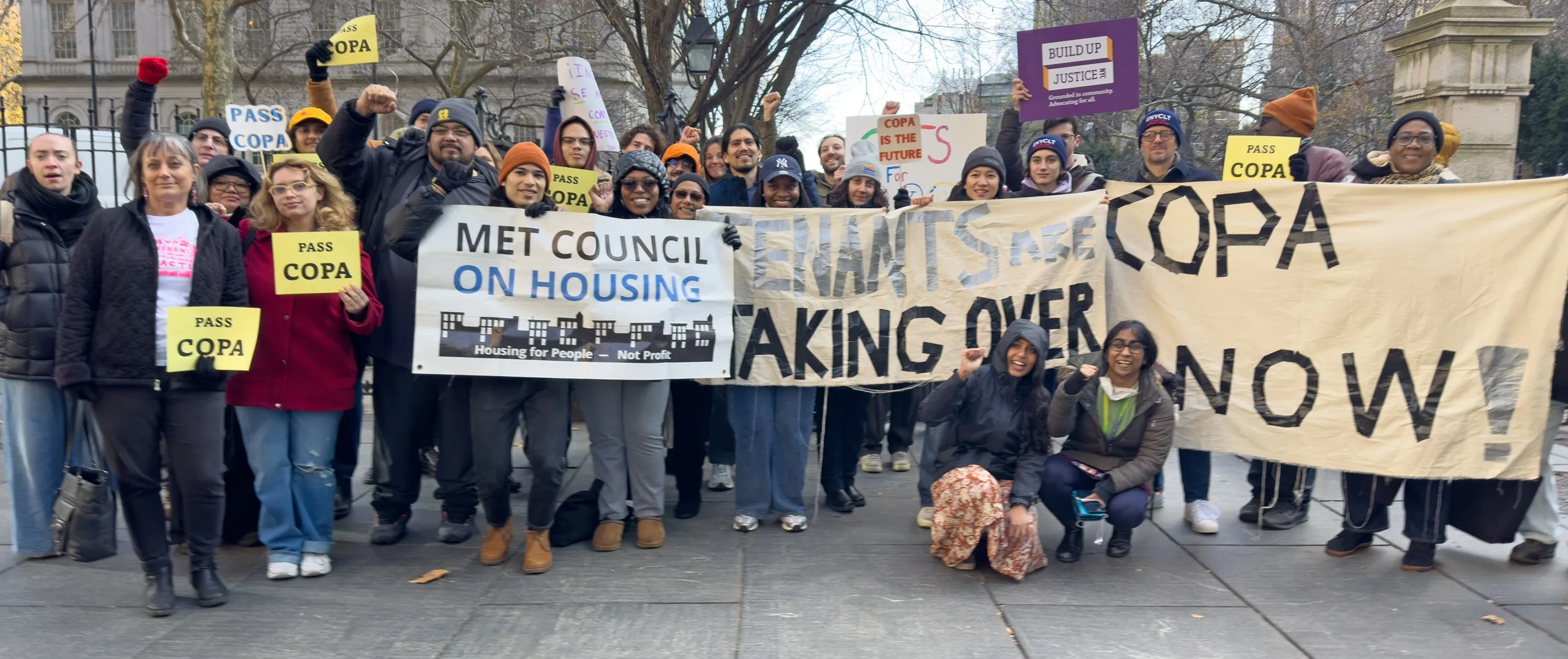
New York, NY – Community groups and electeds rallied at City Hall on Thursday, calling on the NYC Council to pass the Community Opportunity to Purchase Act, or COPA (Intro 902-A), as hundreds of organizations, developers and officials – including Mayor-elect Zohran Mamdani – urge passage of the bill before the end of the year.
The rally follows the release of an updated version of COPA by Council Member Nurse, reflecting months of negotiation among Council Members, advocates, small property owners, and City housing officials. The resulting legislation has broad support across stakeholders.
COPA gives qualified purchasers, including mission-driven nonprofits and community land trusts (CLTs), the first opportunity to purchase certain multifamily buildings when they go up for sale. The policy, modeled on legislation successfully implemented in San Francisco and D.C., is designed to curb speculation, promote responsible ownership, and help community-based affordable housing organizations expand the supply of permanently affordable, community- and tenant-controlled homes. Used in tandem with HPD funding programs like Neighborhood Pillars, COPA will make it easier for community-based housing organizations to compete in the marketplace with cash-rich speculators.
Data from Washington D.C. and San Francisco demonstrates COPA’s effectiveness. In D.C., a COPA-like policy resulted in the preservation or development of over 16,000 affordable homes between 2006 and 2020. In San Francisco, COPA accounts for roughly one in four affordable units preserved citywide, making it one of San Francisco’s most powerful tools for stabilizing neighborhoods.
Since COPA legislation was first introduced in the NYC Council, the policy has amassed support from over 200 stakeholders, including tenant groups, community-based CLTs, mission-driven affordable housing developers, HDFC and Mitchell-Lama cooperators, and youth, community and environmental justice groups.
Speaking to The City this week, the transition team of Mayor-elect Mamdani reiterated its strong support for COPA, calling the policy a “powerful tool” to “stabilize New York City’s distressed housing and increase the supply of affordable housing.”
Most recently, the NYC Commission on Racial Equity urged passage of COPA as a matter of racial and economic justice, citing the lack of truly affordable housing that has led to high rates of displacement for Black and Latinx families.
Quotes
“In last month’s election, New Yorkers sent a powerful message: We need bold solutions to the affordability crisis that ensure all New Yorkers have access to safe, permanently affordable housing,” said Deyanira Del Rio, Executive Director of New Economy Project, which co-founded and coordinates the NYC Community Land Initiative. “COPA gives qualified nonprofit organizations and community land trusts a real opportunity to take land and housing off the speculative market and bring them into permanently affordable community control. We call on Speaker Adams and the City Council to pass COPA and the full Community Land Act now.”
“Working-class New Yorkers shouldn’t be at the mercy of corporate landlords intent on dominating the housing market. The improvements to the Community Opportunity to Purchase Act move us closer to real protections against speculation and displacement. I’m proud that, by working closely with diverse stakeholders, we’ve refined the bill while keeping its central purpose intact: preserving and expanding permanently affordable homes for New Yorkers,” said Council Member Sandy Nurse.“There is an undeniable housing crisis in our city—one characterized by a severe lack of affordability and the active displacement of our older Black and brown neighbors who have resided in New York City for generations. Passing COPA to create deeply and permanently affordable housing that low and moderate income New Yorkers can afford is critical at this juncture,” said Council Member Crystal Hudson, who represents Crown Heights, Prospect Heights, Clinton Hill and Fort Greene. “We saw recently, with a property in the Bronx, how it is possible to put private property in the people’s hands. With COPA, we have an opportunity to do just that on a much larger scale. I’m thankful to Council Member Nurse for leading on this issue, and am proud to stand with her to protect New York families from housing insecurity.”
“New York City must pass COPA as soon as possible. We know from first hand experience how transformative this legislation could be,” said Brianna Soleyn, a board member of the East New York Community Land Trust. “The ENY CLT put in the work to organize residents and donors to directly purchase our first building, which was neglected by its former owner. Through COPA, the city can support acquisitions like these, of over-leveraged rent stabilized housing stock, to ensure that these buildings are kept affordable and under tenant control. These acquisitions are proven to work and directly improve New Yorkers’ lives.”
“Across the Bronx, Northwest Bronx Community and Clergy Coalition and the Bronx Community Land Trust are working together to demonstrate what community-driven development can look like—permanently affordable housing, rooted in local leadership and long-term stewardship,” said Sandra Lobo, Executive Director of the Northwest Bronx Community & Clergy Coalition. “The Community Opportunity to Purchase Act (COPA) would level the playing field for nonprofits and community land trusts to support and expand this work, in the Bronx and beyond. Now is the moment for the City Council to pass COPA and strengthen the infrastructure that would support New Yorkers to remain in the neighborhoods they’ve helped build.”
“Our city’s affordability crisis demands bold, community-driven solutions—and COPA is exactly that,” said Council Member Shahana Hanif, who represents Kensington, Park Slope, Carroll Gardens, the Columbia Waterfront and other neighborhoods in Brooklyn. “In my district, at 63 Tiffany Place, tenants have been fighting to keep their homes after their building was put up for sale. COPA would give residents like them, and community-based nonprofits, the first opportunity to purchase their buildings—removing housing from the speculative market and keeping it permanently affordable. This legislation would stabilize families, preserve culture, and keep New Yorkers rooted in the neighborhoods they’ve built. It’s time to pass COPA and the full Community Land Act.”
“Speculators are preying on working-class neighborhoods like mine, buying up previously affordable housing and accelerating gentrification. COPA would put more power in the hands of tenants. Now, community land trusts and nonprofits can help New Yorkers stay in their homes and maintain what affordable housing stock we do have,” said Council Member Alexa Avilés.
“COPA would be a game-changer for neighborhoods in the South Bronx that face severe displacement pressures, such as Mott Haven,” said Matthew Shore, Director of Planning & Development at South Bronx Unite. “Mott Haven ranks amongst the highest in the city for rent burden, evictions, and housing code violations. At the same time, new housing units produced at or above 80% AMI in our community district were double that of units at or below 80% AMI. We know that CLTs and nonprofit developers have a better track record of affordable housing development than for-profit developers, and COPA is a long-overdue legislation that we need to preserve our working-class communities and address our city’s affordability crisis.”
“Last year, this Land Is Ours CLT participated in a successful bid to develop 500 affordable homes on the site of a shuttered Catholic church,” said Valerio Orselli, Project Director of This Land Is Ours CLT. “Among other projects, we are currently working with the tenants of 438-440 West 45th Street and 331 East 14th Street and a Preservation Purchaser to acquire homes previously-owned by slumlord Ohebshalom. COPA would make these challenging acquisition processes far more efficient. City Council, we need COPA now!”
“Having lived in the same apartment in Hell’s Kitchen for more than forty years and having witnessed firsthand the devastating effects the action and inaction of a predatory landlord has had on my fellow tenants and neighbors, I believe it is high time that the city allow the community to decide for itself what is in its own best interest,” said Nicholas Latimer, Tenants’ Association leader at 438/440 W. 45th Street, apartment buildings formerly owned by Daniel Ohebshalom, a NYC ‘worst landlord’ as declared by the NYC Public Advocate’s Office. “It does not take an army of outside developers to shape the future of our shared spaces. It takes a village. And the village is ready, willing, and more than able to do the necessary work.”
“NYC is facing a critical shortage of deeply affordable housing, small business and cultural spaces, and public green spaces,” said Jenny Dubnau, Co-Chair of the Western Queens CLT. “COPA would help Western Queens CLT to transform existing housing in Queens so it’s permanently affordable and tenant-controlled. In addition, we must pass another key component of the Community Land Act (CLA) package: Public Land for Public Good Act, which would require NYC to prioritize CLTs and nonprofit developers when disposing of City-owned land. In Long Island City, Queens, there are four publicly-owned waterfront sites which the City is upzoning for residential use. If the PLFPG bill was enacted, it would prioritize development of sites like these to mission-driven non-profits and CLTs, who can provide far deeper affordability than for-profit developers. Let’s pass the entire CLA package!”
“Cooper Square Committee fully supports the Community Land Act and calls on New York City to pass it this year,” said Illapa Sairitupac, a Housing Organizer at Cooper Square Committee. “Our organization frequently works with tenants whose lives are upended when their building is sold to a neglectful corporate landlord. TOPA and COPA will give tenants the ability to facilitate needed improvements and preserve the affordability of their buildings in perpetuity. Such policies have already proven successful in places like Washington, D.C., and it’s high time New York brought them here. Now with federal cuts to affordable housing, we need the CLA to pass more than ever.”
“Right here in Queens, our community land trust is proving it’s possible to take land off the speculative market and develop deeply affordable homes and community spaces, all while putting people over profit,” said Alexis Foote, founder of the ReAL Edgemere Community Land Trust in the Rockaways. “We see COPA as a crucial step toward reparations for Black communities harmed by decades of redlining and disinvestment. Let’s pass COPA and Public Land for Public Good to give all New York City’s tenants and CLTs the tools they need to bring land into community control.”
“Passing COPA will level the playing field for tenants and the community-based organizations when properties hit the market. The Community Land Act strikes a balance between tenant power and property rights, pointing to a City that generations of working-class New Yorkers will be able to call home,” said Paula Z. Segal, Senior Staff Attorney in the TakeRoot Justice Equitable Neighborhoods unit. “In addition, TakeRoot is grateful for the leadership of our Council allies for working to abolish and replace Guiliani’s lien sale with a municipal debt collection system that is accountable to our neighborhoods and sensitive to the needs of both tenants and homeowners.”
“COPA and TOPA would let residents like us stay in our homes and keep our neighborhoods from becoming playgrounds for the wealthy. The tenants in this city are at a disadvantage, fighting against millionaires, billionaires, and increasingly, private equity. It’s a David vs. Goliath fight. Let’s pass the Community Land Act in the City Council and TOPA in the State Legislature to level the playing field,” said John Leyva, a tenant leader at 63 Tiffany Place.
“St. Nicks Alliance urges the passage of the Community Opportunity to Purchase Act (COPA), and we are incredibly grateful for the leadership of Councilwoman Sandy Nurse in spearheading this historic campaign,” said Rolando Guzman, Deputy Director Community Preservation at St Nicks Alliance. “This legislation will provide organized tenants across New York City with new tools to interrupt the cycle of sales and purchases of over-leveraged, rent-stabilized buildings. It offers tenants a crucial first opportunity to purchase their homes, thereby preventing the displacement of more rent-stabilized residents.”
“Nonprofit developers and community-based organizations like WHEDco exist for one purpose: to put people and communities first. In neighborhoods where speculative, for-profit ownership can destabilize families and drive displacement, it is essential that mission-driven organizations have the ability to own and steward the physical assets that anchor community life. We have seen firsthand in the Bronx how stable, affordable housing preserves culture, strengthens local economies, and allows generations of families to remain rooted in the places they call home,” said Davon Russell, President of the Women’s Housing and Economic Development Corporation (WHEDco). “The Community Opportunity to Purchase Act—paired with sufficient financing and support from New York City—would give nonprofits the first chance to acquire and preserve buildings in a cash-driven market, ensuring that long-term affordability and community-serving infrastructure remain in the hands of those who are accountable to residents themselves. COPA is not just a policy tool; it is a powerful commitment to sustaining the communities and cultures that make New York City extraordinary in the eyes of the world.”
“The Community Opportunity to Purchase Act is a vital tool to combat displacement and preserve affordability in our neighborhoods. For decades, the Fifth Avenue Committee has worked to ensure that low- and moderate-income New Yorkers can remain in the communities they helped build. COPA empowers mission-driven nonprofits like ours to compete with speculative buyers and ensure housing remains affordable for community residents for generations to come. We urge the City Council to pass this legislation and give communities a fighting chance to stay rooted,” said Michelle de la Uz, Executive Director of the Fifth Avenue Committee.
“As we continue to face a housing and homelessness crisis, we must commit to building and preserving affordable housing for those who need it most,” said Will Depoo, Senior Campaign Organizer at the Association for Neighborhood and Housing Development. “COPA provides our communities with a key tool to fight speculation, move distressed buildings into the hands of responsible community stewards, and ensure that public resources go where they’re most needed.”
“The Belmont Arthur Ave Local Development Corporation supports the enactment of the Community Opportunity to Purchase Act by the City Council as an important housing stabilization tool to foster and help preserve affordable housing throughout New York City and especially in the Bronx where BAALDC owns and manages thousands of units,” said Joseph Cicciu, Executive Director of Belmont Arthur Ave LDC. “When and if privately owned buildings fall into foreclosure and lack the resources to remain viable, their deterioration undermines neighboring properties like ours and contributes to the deterioration of the communities surrounding them.”
“Offering non-profit Community Development Organizations a right of first offer and right of refusal when privately owned buildings are placed on the market for sale would yield enormous benefits for communities across New York City,” said Yvonne Stennett, Executive Director of Community League of the Heights (CLOTH). “First, it will help curb speculation and the ill-desired effect of displacement that often accompanies it—particularly in rapidly gentrifying neighborhoods. The COPA initiative would also expand New York City’s affordable housing inventory. It would enhance the viability of HPD Neighborhood Pillars Program, which would in turn help stabilize communities by ensuring that properties are rehabilitated and made affordable, with a focus on long term neighborhood development rather than the short-term term profit motive that generally accompanies private developments.”
“We have been involved with the fight to preserve and create affordable housing around Jamaica for more than 50 years. We have approached this issue from multiple angles and the Community Land Act is a common sense tactic that includes measures proven successful in other cities,” said Justin Rodgers, President & CEO of the Greater Jamaica Development Corporation. “Furthermore, this bill gives communities more control of their own present and future. We urge the NYC Council to pass this important legislation.”
“Through COPA, nonprofits like The Doe Fund would be able to fast-track highly affordable housing with on-site supportive services for our most vulnerable neighbors. We know this model works; last year, we opened a new residence through a similar program — providing long-term stability for 64 New Yorkers. We urge the City Council to pass COPA and bring the affordable housing this city so desperately needs,” said John McDonald, Executive Vice President of Real Estate at The Doe Fund.
“The Youth Alliance for Housing is made of young people from New York, and we are fighting to ensure we can grow old in the communities we grew up in. We refuse to let our city turn into a glass playground for the rich. COPA will be critical in preventing the displacement of long standing residents and preserving affordable housing in NYC,” said Justin Liriano, a member leader at The Youth Alliance for Housing.
“Cooperators United for Mitchell-Lama (CU4ML) strongly supports the passage of COPA, which will assist in preserving and transforming multifamily buildings into affordable social housing that is controlled by the local community. Imagine another round of neighborhood renaissances such as that which flowed from the housing stability produced by Mitchell-Lama cooperatives over the past 60 years!” said Adele Niederman, president of CU4ML.
“For domestic violence survivors, who are often left with nothing after escaping an abusive relationship, having a safe and affordable place to call home is the first step toward recovery and healing. As rent levels in New York continue to see record highs, the Community Opportunity to Purchase Act gives our city the opportunity to put more units into the hands of nonprofits that are committed to creating and preserving the affordable homes that survivors and many other New Yorkers need,” said Nicole Branca, CEO of New Destiny Housing. “We look forward to working with Council Member Nurse and our nonprofit peers to ensure COPA is passed in New York City.”
“COPA is a crucial step forward to keep homes affordable and in community hands while creating new pathways to homeownership for lower-income New Yorkers. Speculation is still squeezing out long-term owners and boxing out new buyers, and the tax lien sale puts another target on the homes of our vulnerable neighbors,” said Christie Peale, CEO and Executive Director of the Center for NYC Neighborhoods. “The Council should pass COPA now and end the tax lien sale for good. Together we can help shape a new housing ecosystem that supports ownership models tailored to our communities and increases access to homeownership for a more equitable New York.”
“The Cypress Hills Local Development Corporation stands in strong support of the Community Opportunity to Purchase Act. This policy would be a game-changing vehicle for the preservation of affordable housing in neighborhoods like East New York,” said Michelle Neugebauer, executive director of Cypress Hills Local Development Corporation, Inc. “Paired with adequate funding, COPA would give mission-driven developers the tools to bring much-needed repairs and permanent affordability to thousands of units citywide. We call upon the City to pass this legislation and implement it without delay.”
“For decades, Carroll Gardens Association has fought to keep Brooklyn affordable for working families by developing and managing housing, and advocating for tenant rights. In the neighborhoods in Southwest Brooklyn, however, we see every day how gentrification threatens to displace long-time residents and makes it increasingly difficult for families to set down roots,” said Ben Fuller-Googins, executive director of Carroll Gardens Association. “The Community Opportunity to Purchase Act is exactly the kind of tool we need to protect tenants and preserve affordability. We urge the City Council to move now and pass these bills before the end of the year.”