BILL TARGETS APP-BASED LENDERS PUSHING TRIPLE-DIGIT INTEREST DEBT-TRAP PAYDAY LOANS ON LOW-WAGE WORKERS AND COMMUNITIES OF COLOR
88% OF NEW YORKERS SUPPORT CRACKDOWN ON PREDATORY APPS, NEW POLL FINDS
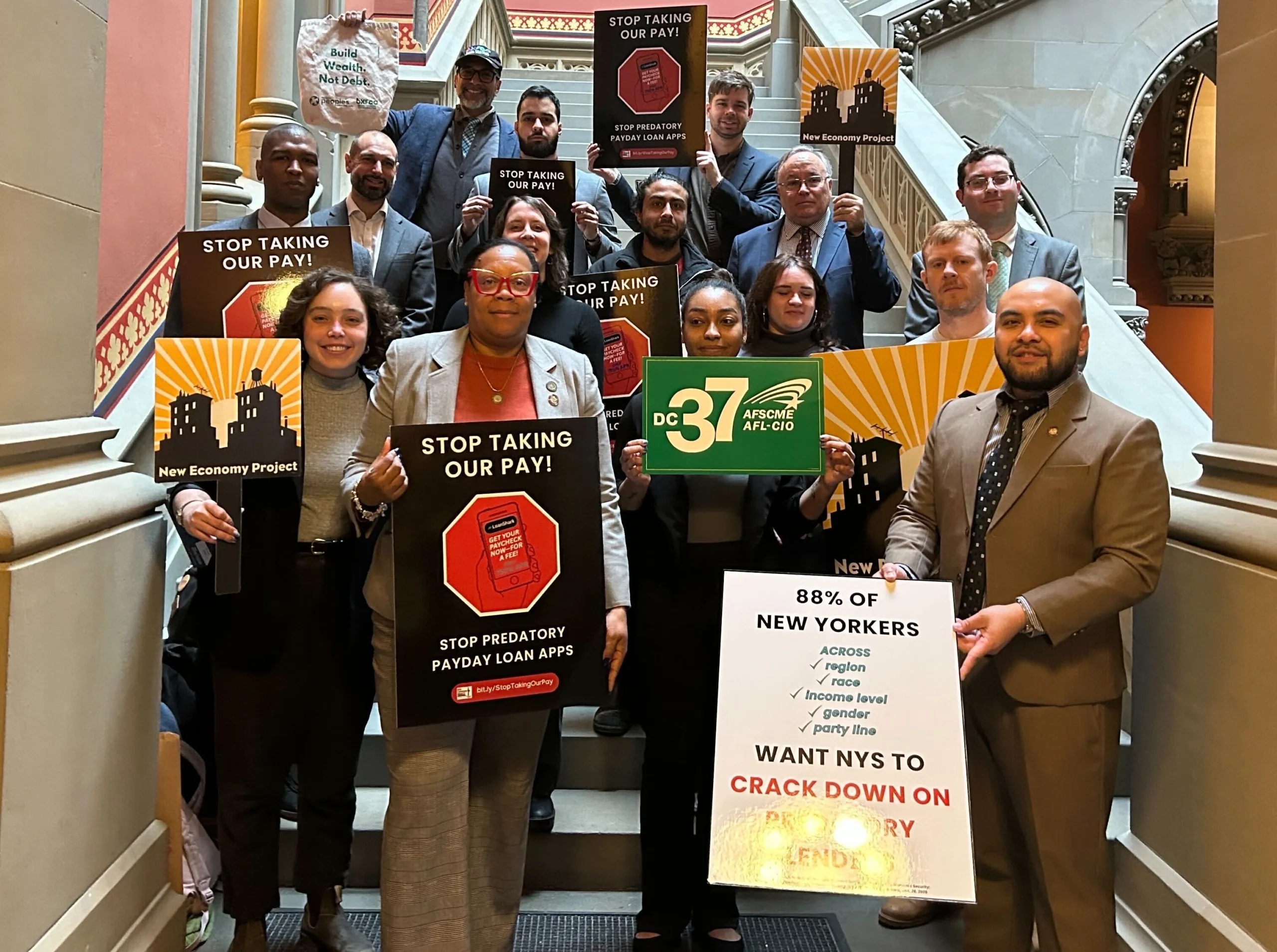
Albany, NY – On Tuesday, community groups, community development credit unions, and impacted New Yorkers from across the state joined lawmakers at the State Capitol to announce the introduction of the Stop Taking Our Pay (STOP) Act (S8939, A9644) sponsored by State Senator Samra Brouk of Rochester and Assemblymember Steven Raga of Queens. The STOP Act would crack down on so-called “Earned Wage Access” companies pushing illegal, triple-digit-interest payday loans on low-wage workers through deceptive phone apps.
Backed by Silicon Valley venture capitalists and Wall Street investors, EWA companies market app-based “no interest” cash advances, but extract profits from workers by driving repeat use while charging deceptive fees; one common loan made to New Yorkers carries an effective interest rate above 750% APR, according to the NYS Attorney General. Studies show that 75% of customers reborrow on the same day or the day after repaying a prior loan, and most users double their borrowing frequency within the first year of use — facts that expose the industry’s exploitative business model and its track record of perpetuating workers’ financial distress.
Because companies require direct access to workers’ bank accounts, payday loan app companies are all but guaranteed repayment – with egregious long-term impacts on low-wage workers. The industry has extracted well over $500 million from New Yorkers’ paychecks since 2019. Bank overdrafts increase 56% on average after use of an EWA product.
At the press conference, advocates revealed the results of a new poll conducted by the Community Survey Society of New York. The poll found that 88 percent of New Yorkers agree that payday loan apps should be regulated under the state usury laws, which make it a felony to charge more than 25% APR on a loan. While New York’s usury laws have long protected New Yorkers and kept predatory payday lenders out of the state, EWA companies deliberately evade the law by claiming they are not lenders. The STOP Act would make it clear under New York law that EWA advances are loans and that fees and “tips” must be counted as interest.
At the press conference, Queens resident Jose Bedoy described their struggle to keep up with the rising cost of living, and how the app company Dave took advantage of this distress, trapping them in a cycle of repeat borrowing. The app charged fees for immediate access to Bedoy’s own wages, and used manipulative and misleading messaging to pressure Bedoy to tip the software.
Advocates cited studies showing Bedoy’s story is far from unique, especially among young people, Black and Brown New Yorkers, and New Yorkers making less than $50,000. Nearly a third of New Yorkers under the age of thirty use payday loan apps “frequently or all the time,” according to a separate study by the Community Service Society of New York. EWA companies perpetuate the legacy of predatory racial wealth extraction, with Black and Latino workers almost 60 percent more likely to use payday loan apps.
The press conference comes as the NYS Attorney General sues two major payday lending apps, DailyPay and MoneyLion, for allegedly pushing tens of thousands of New Yorkers into short-term, high-interest, illegal payday loans, and as courts and state governments across the country affirm that app-based advances should be treated as loans and subject to state usury laws.
In 2024, under the Biden administration, the Consumer Financial Protection Bureau (CFPB) proposed a rule to clarify that EWA products were indeed loans, to be regulated under the federal Truth in Lending Act. Now the Trump administration has taken a hatchet to the CFPB, dismantling worker and consumer protections—and obstructing efforts to reign in payday loan apps.
At the press conference, speakers emphasized that in the wake of these federal rollbacks, Albany must take immediate action to crack down on payday loan apps by enacting the STOP Act. They also called on state leadership to address the root causes of poverty and financial insecurity – the lack of living wages, the persistent racial wealth gap, and the growing affordability crisis statewide – rather than give financial technology companies free rein to exploit New Yorkers under the guise of “innovation.”
Speakers additionally urged state leaders to support the growth of the state’s community development credit unions, which already serve historically redlined and low-income communities with responsible credit options, by passing The New York Public Banking Act and investing in the state’s CDFI Fund.
QUOTES
“Predatory payday lending is illegal in New York – and no amount of slick branding or semantic games changes that. EWA payday lenders make loans, charge triple-digit interest, and trap workers in debt,” said Katy Lasell, State Campaigns Coordinator at New Economy Project. “We urge Albany to pass the STOP Act immediately and put an end to predatory payday loan apps exploiting New Yorkers. In addition, New York must invest in community development credit unions and other locally rooted organizations with a long track record of serving redlined communities, providing responsible credit, and building community wealth.”
“For too long, predatory payday lenders have been evading consumer protection laws and using clever tactics to trap low-income individuals and people of color in never ending cycles of debt,” said State Senator Samra Brouk, who represents Rochester and its eastern suburbs. “The STOP Act (S8939) will close loopholes in New York’s usury laws by ensuring that wage and cash advances are subject to usury rate caps to protect vulnerable residents and promote economic justice.”
“Working people should never have to pay triple-digit interest just to access the wages that they’ve already earned. These payday loan apps prey on workers living paycheck to paycheck—especially immigrants, young people, and communities of color—by hiding exploitative fees behind slick tech and false promises,” said State Assemblymember Steven Raga, who represents Queens. “The STOP Act closes these loopholes once and for all and makes clear that predatory lending is illegal in New York, no matter what form it takes. At a moment when federal protections are being rolled back, Albany has a responsibility to stand up for working families and put people over profits, and I’m proud to work with Senator Brouk and my colleagues in the Assembly to move this bill through the People’s House and deliver real protections for New Yorkers.”
“Earned wage access companies are payday lenders by another name. As my office’s investigations have shown, these companies charge consumers outrageous interest rates and trap New Yorkers in debt. Their predatory tactics are making life even less affordable for working families, and I applaud Senator Brouk and Assemblymember Raga for their work to stop these companies from taking advantage of New Yorkers,” said New York State Attorney General Letitia James.
“The STOP Act is about stopping a modern payday loan scam that targets low-wage workers and communities of color through deceptive phone apps,” says Assemblymember Marcela Mitaynes. “These so-called ‘earned wage access’ companies are charging triple-digit interest, trapping New Yorkers in cycles of debt that would already be illegal if they weren’t hiding behind technology. New Yorkers have been clear: predatory lending has no place in our state. The STOP Act closes dangerous loopholes, enforces our 25 percent usury cap, and puts working people before corporate profit.”
“At first, the app Dave seemed like the lifeline I needed to stay afloat. Then I watched every paycheck get gutted as soon as it hit my account, leaving my bank account near-empty and forcing me to borrow again, each time with more fees. The cycle repeated for months, ” said Jose Bedoy, an affected Queens resident. “If state lawmakers are actually serious about making New York affordable, they’ll pass the STOP ACT while tackling the root causes of poverty and supporting real economic transformation.”
“Paycheck advance apps entice workers with come-ons about low-cost advances, but they can cost 10 times as much as a credit card for a very short-term loan,” said Chuck Bell, advocacy programs director for Consumer Reports. “Research has shown that they have a very high rate of repeat usage, so consumers can lose literally hundreds of dollars from their pay each year, just to pay for fees and tips. The proposed STOP Act will make clear that paycheck advance apps are explicitly subject to New York banking laws and usury limits, so that New Yorkers won’t be cheated out of their hard-earned pay.”
“Our annual statewide poll shows that 88 percent of New Yorkers—across the political spectrum and geographic regions—support closing the loopholes that let fintech apps evade the state’s interest rate cap. The Stop Taking Our Pay Act addresses this directly by ensuring earned wage access products are regulated as loans, protecting workers from predatory lending and safeguarding the communities our research shows are most vulnerable—especially younger workers and Black and Latino New Yorkers already navigating economic insecurity,” said Rachel Swaner, Vice President of Policy, Research, & Advocacy at the Community Service Society of New York.
“Community Development Credit Unions like Genesee Co-op have a long history of serving historically redlined and low-income communities with responsible financial services. This includes offering affordable, fairly priced loans to our members to help them build wealth and deal with emergencies. In contrast, payday loan apps operate without interest rate caps. They extract money from communities, benefitting from and increasing the cycle of precariousness affecting so many New Yorkers,” said Dan Apfel, the CEO of Genesee Co-op Federal Credit Union. “We urge New York State to pass the STOP Act, and to expand New Yorkers’ access to Community Development Financial Institutions.”
“Earned Wage Access apps are intentionally misleading. They take advantage of the most vulnerable financially and are designed to create a pattern of repeat borrowing and dependency,” said Rebecca Pear, Chief Experience Officer at Brooklyn Cooperative Federal Credit Union. “As a CDFI, Brooklyn Coop protects our community members from the cycle of debt that predatory Earned Wage Access loan apps are specifically designed to create. NY State has a commendable history of protecting consumers from predatory lending. The STOP Act is an important addition to address the loophole EWA app companies have created to evade NY State usury laws.”
“Our parishioners are predominantly people of color, especially in Brooklyn and Queens, who never recovered from the redlining and financial consequences of segregation that were carried out in decades past. Now, they have to contend with new and shiny technology that is extracting wealth from their already deeply distressed communities. These “fintech” apps are nothing more than payday loans: pawn shops and loan sharks that live inside their smartphones,” said the Rev. Canon Marie A. Tatro, Canon for Community Justice Ministry, Episcopal Diocese of Long Island. “The extraction of resources and wealth from our communities is counter to what my faith — and frankly, counter to what basic decency — calls us to do. We must pass the STOP Act, and remove yet another bad actor from my parishioners’ lives.”
“We love it when our elected officials partner with and support the work that is led by community residents,” said Gregory Jost of Banana Kelly Community Improvement Association. “That’s why we have been working hard as part of the Bronx Financial Access Coalition to build up the Bronx People’s Federal Credit Union where the same people who are targeted by these predatory payday loan apps can instead become members of a financial cooperative and access quality, affordable, and convenient financial services that help them build wealth, not debt!”
“At a time when families are struggling just to make ends meet, payday loan apps are charging workers triple-digit interest just to access their own wages. The STOP Act is a critical step toward an economy that builds community wealth instead of extracting it,” said Nada Khader, WESPAC Foundation Director.
“It’s time to stop the immoral and exorbitant extraction of wealth from those least able to afford these payday loans,” said Dr. David Sprintzen, Ethical Humanist Society of Long Island. “The New York legislature must pass the STOP Act.”