Contact: Will Spisak, will@neweconomyproject.org
After Adams veto, 200+ community groups and Mayor Mamdani back COPA to preserve affordable housing and prevent displacement in Black and Brown communities.
Mayor Mamdani: “The Community Opportunity to Purchase Act is about putting power back in the hands of the people.”
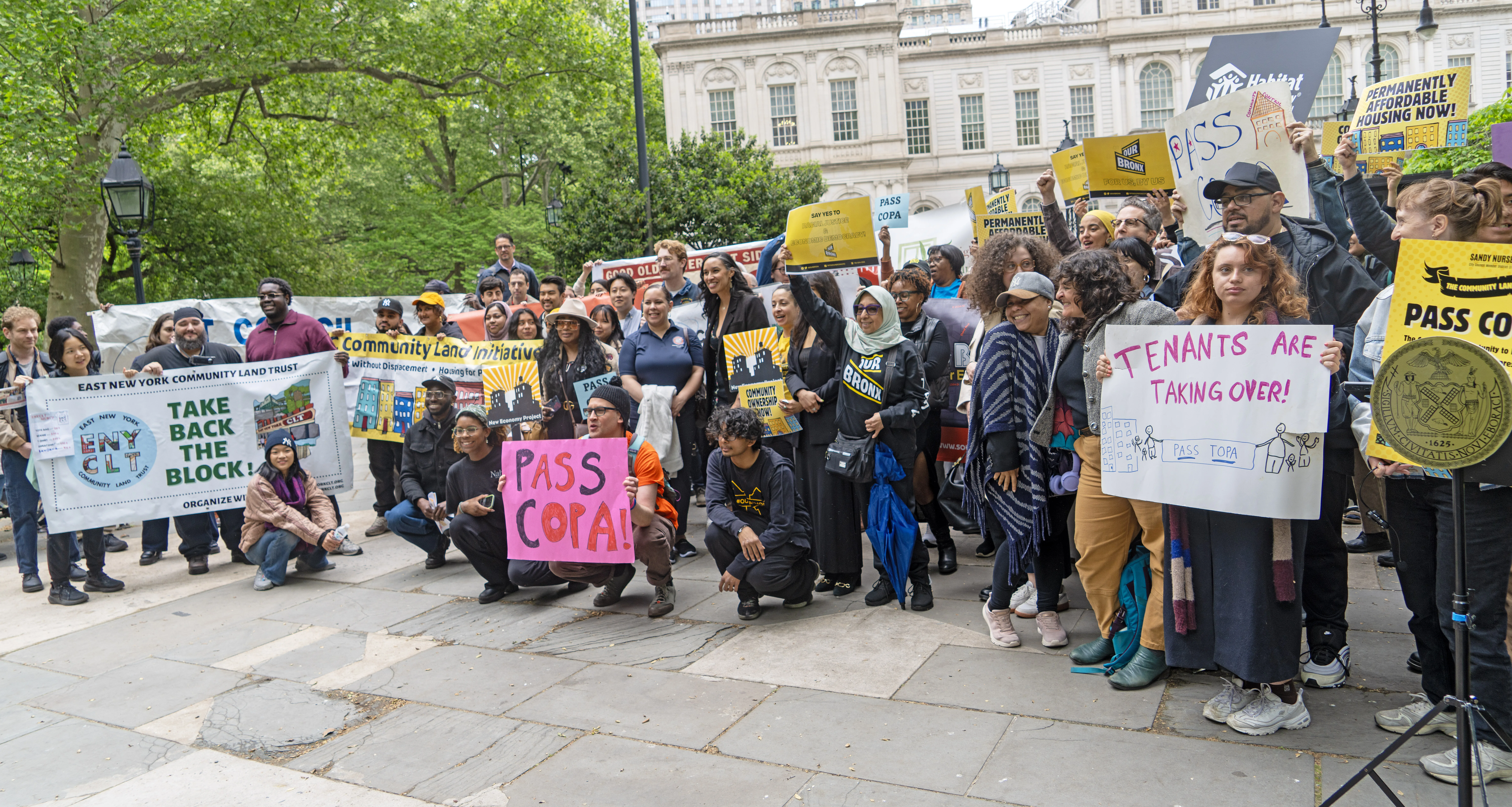
NEW YORK, NY – Tenants, affordable housing organizations, and elected officials gathered at City Hall on Thursday with NYC Council Member Sandy Nurse to announce the reintroduction of the Community Opportunity to Purchase Act (COPA), landmark legislation aimed at combating displacement, preserving affordable housing, and expanding community ownership amid New York City’s deepening housing crisis.
COPA would give community land trusts (CLTs) and other qualified mission-driven affordable housing organizations the first opportunity to purchase certain at-risk multifamily buildings when landlords decide to sell, helping keep housing permanently affordable and rooted in community control. The legislation is backed by more than 200 organizations – including CLTs, tenant associations, developers, and housing experts – as well as Mayor Zohran Mamdani.
Modeled on successful policies in San Francisco and elsewhere, COPA would create a powerful new preservation tool to stabilize buildings most vulnerable to speculative investment and displacement while expanding permanently affordable, community- and tenant-controlled housing across New York City. The legislation previously passed the Council with a strong majority in December before being vetoed by former Mayor Eric Adams on his final day in office.
In the months since, Council Member Nurse has worked with fellow Council Members, HPD, housing groups, property owners, and other stakeholders to strengthen the legislation ahead of its reintroduction.
Key updates to the legislation:
- Streamlines the timeframe qualified entities (QEs) have to make an offer and enter a contract of sale, including:
- Reducing the window for QEs to signal interest and to make a fair-market offer from 25 to 20 and 80 to 70 days, respectively; and
- Limiting previously undefined extensions to the right of first offer period to a maximum of two possible 5-day extensions upon a showing of need.
- Gives QEs more flexibility to partner and lead joint ventures with other non-profits, as well as M/WBEs and other affordable housing developers.
- Ensures QEs can partner with community land trusts (CLTs) to reach deep, permanent affordability.
- Excludes buildings with 421a tax abatements and limits other covered buildings with expiring regulatory agreements to 100 or fewer units.
- Standardizes definition of building distress to an annual average of 3 or more open hazardous or immediately hazardous violations per unit.
Quotes:
“After months of negotiating with community and housing organizations, industry stakeholders, labor, and Administration officials, I am so excited to reintroduce a stronger Community Opportunity to Purchase Act,” said Council Member Sandy Nurse, the bill’s lead sponsor. “This bill will give our city a desperately-needed preservation tool to prevent distressed and other at-risk multifamily buildings from falling into speculators’ hands, helping disrupt the harmful cycle of eviction, flipping, and gentrification. Instead of leaving these buildings to the whims of the private market, COPA will help even the playing field for qualified nonprofits to stabilize our neighborhoods, keep people in their homes, and keep housing affordable.”
“Tenants and community organizations across New York have spent years watching their neighborhoods be priced out from under them while speculators reap the rewards,” said Mayor Zohran Kwame Mamdani. “The Community Opportunity to Purchase Act is about putting power back in the hands of the people. I’m proud to support this legislation and grateful to Councilmember Nurse for partnering with our administration, advocates and
organizers to bring it forward once again. I look forward to working with the City Council to pass this important bill and protect the affordability and future of our neighborhoods.”
“We need bold solutions to the affordability crisis that bring land and housing into permanently affordable community ownership,” said Deyanira Del Rio, Executive Director of New Economy Project. “COPA does exactly that. Backed by 200+ tenant, community, and affordable housing groups, COPA gives communities and the city a powerful new tool to stabilize buildings, combat displacement of low income and Black and Brown New Yorkers, and build lasting community wealth. We call on Speaker Menin and the City Council to pass COPA immediately.”
“Housing affordability is a major concern for all UAW members and especially for members who rent in the five boroughs of New York City. Unfortunately, status quo housing policies have failed to address one of the root causes of the affordability crisis—predatory real estate speculation,” said Jane Fox, Chairperson UAW Region 9A NY Area CAP Council. “If we want a city that working-class New Yorkers can call home, we must bring more housing into community and tenant control. UAW Region 9A calls on City Council to pass COPA immediately.”
“New Yorkers are struggling to stay in their homes, and with some of the lowest vacancy rates in decades, we need bold preservation tools that center tenants and community needs so they can remain housed,” said Council Member Jennifer Gutiérrez. “COPA creates a pathway for permanently affordable, community-controlled housing while helping prevent the cycle of eviction, flipping, and displacement that too many families across my district know too well. I’m proud that CM Nurse has remained steady on this legislation and I am proud to support COPA.”
“As we continue to face a housing, homelessness, and affordability crisis, we must commit to preserving affordable housing for those who need it most,” said Will Depoo, Senior Campaign Organizer at the Association for Neighborhood and Housing Development. “COPA provides our communities with a key tool to fight speculation, move distressed buildings into the hands of responsible community stewards, and ensure that public resources go where they’re most needed.”
“For too long, profit-seeking corporations have displaced Black and brown New Yorkers from their homes,” said Council Member Tiffany Cabán. “COPA will give people the opportunity to turn their buildings into permanently affordable community-controlled homes. We must pass COPA now to mitigate the cycle of displacement.”
“New Yorkers cannot afford for the City to wait while more buildings are sold into a speculative market that too often turns homes into investment vehicles and pushes working-class families out of the neighborhoods they built. COPA gives us a practical tool to act before displacement happens by giving mission-driven nonprofits, community land trusts, and responsible partners a fair chance to preserve housing for long-term affordability and community stewardship,” said Sandra Lobo, Executive Director of Our Bronx. “At Our Bronx, we believe the affordability crisis will only be solved by pairing production with preservation. We must protect the homes that already exist, keep people rooted, and build the infrastructure for communities to co-own and co-govern their future. Now is the time to pass COPA.”
“Housing affordability is the number one issue I hear about from my constituents,” said Council Member Shahana Hanif. “Trusted community organizations like the Fifth Avenue Committee are ready to create and preserve deeply affordable homes, yet too often they’re pushed aside while profit-driven developers take over, driving displacement. COPA gives these organizations a fair opportunity to protect affordable housing and put people before profit.”
“COPA is a vital tool that would help Western Queens Community Land Trust address the affordable housing crisis impacting our neighborhoods. We have been approached multiple times by tenants who seek our help buying their building from negligent landlords, only to have it sold out from under us in the open market before we could make an offer,” said Jenny Dubnau, Board Co-Chair at Western Queens CLT. “The passage of COPA will help us to guarantee tenants’ rights, end ongoing negligence, and secure stable, decommodified housing for our communities. And to make COPA even more effective, it should come with a major capital fund for building purchases.”
“For decades, the Fifth Avenue Committee has worked to ensure that low- and moderate-income New Yorkers can remain in the communities they helped build. We are seeing more and more tenants facing the uncertainty that comes when the properties they have called home are under threat due to foreclosure, bankruptcy or other challenges,” said Michelle de la Uz, Executive Director of the Fifth Avenue Committee. “The Community Opportunity to Purchase Act is a vital tool to combat displacement and preserve affordability in our neighborhoods. COPA empowers mission-driven nonprofits like ours to compete with speculative buyers and ensure housing remains affordable for community residents for generations to come. We urge the City Council to pass this legislation and give communities a fighting chance to stay rooted.”
“COPA gives tenants and mission-driven nonprofits the first opportunity to buy certain buildings when they go up for sale, helping preserve affordability and prevent displacement. We have a real opportunity to pass COPA in the New York City Council and to stand with tenants fighting to stay in their communities,” said Council Member Harvey Epstein.
“New York City is in the midst of an acute affordability crisis. Our member neighborhood houses report housing insecurity is one of the most pressing challenges facing their communities,” said Anita Kwok, Policy Analyst at United Neighborhood Houses. “Our current policies are simply insufficient to address the current demand for truly affordable housing. The Community Opportunity to Purchase Act puts the organizations with the deepest roots in these communities in a position to preserve affordability, prevent displacement, and build housing that is truly affordable for the neighborhood populations they serve.”
“New York City must pass COPA as soon as possible. We know from first hand experience how transformative this legislation could be,” said Brianna Soleyn, a board member of the East New York Community Land Trust. “The ENY CLT put in the work to organize residents and donors to directly purchase our first building, which was neglected by its former owner. Through COPA, the city can support acquisitions like these, of over-leveraged rent stabilized housing stock, to ensure that these buildings are kept affordable and under tenant control. These acquisitions are proven to work and directly improve New Yorkers’ lives.”
“COPA would be a game-changer for neighborhoods in the South Bronx that face severe displacement pressures, such as Mott Haven,” said Matthew Shore, Director of Planning & Development at South Bronx Unite. “Mott Haven ranks amongst the highest in the city for rent burden, evictions, and housing code violations. At the same time, new housing units produced at or above 80% AMI in our community district were double that of units at or below 80% AMI. We know that CLTs and nonprofit developers have a better track record of affordable housing development than for-profit developers, and COPA is a long-overdue legislation that we need to preserve our working-class communities and address our city’s affordability crisis.”
“Two years ago, This Land Is Ours CLT participated in a successful bid to develop 500 affordable homes on the site of a shuttered Catholic church. We are currently working with the tenants of 438-440 West 45th Street and 331 East 14th Street and a Preservation Purchaser to acquire homes previously-owned by slumlord Ohebshalom, and we’re at a critical stage in our negotiations with the current owner,” said Valerio Orselli, Project Director of This Land Is Ours CLT. “With COPA in place, we are confident we’d be able to strike a deal that ensures the permanent affordability of the housing.”
“When UHAB helped South Bronx tenants purchase their building in 2022 with the goal of creating an affordable HDFC co-op, it set off a movement of tenants across New York City demanding control of their homes,” said Arielle Hersh, Director of Policy and New Projects at UHAB. “The Community Opportunity to Purchase Act (COPA) would give tenants that path by partnering with mission-driven purchasers to create a new pipeline of social housing. In a moment where we are seeing record-high rates of multifamily foreclosures and distress from decades of speculation and disinvestment, we need policies like COPA to turn crisis into opportunity—removing properties from the speculative market and stabilizing them as the high-quality, safe, affordable homes New Yorkers deserve.”
“Right here in Queens, our community land trust is proving it’s possible to take land off the speculative market and develop deeply affordable homes and community spaces, all while putting people over profit,” said Alexis Foote, founder of the ReAL Edgemere Community Land Trust in the Rockaways. “We see COPA as a crucial step toward reparations for Black communities harmed by decades of redlining and disinvestment. Let’s pass COPA and Public Land for Public Good to give all New York City’s tenants and CLTs the tools they need to bring land into community control.”
“TakeRoot is thrilled to see COPA reintroduced today,” said Paula Z. Segal, Senior Staff Attorney in the TakeRoot Justice Equitable Neighborhoods unit. “Tenants in covered buildings will have the power to partner with trusted organizations to get buildings out of physical distress and preserve long-term affordability.”
“The Youth Alliance or Housing is a collective of young organizers fighting for the right to remain in the city we love. Our city is becoming a playground for billionaires who profit off our corrupt system of housing. It doesn’t have to be this way, though! City Council can and must pass COPA in order to ensure all New Yorkers can fight displacement and preserve affordable housing here in NYC,” said Kasey McNaughton, Director of Organizing at The Youth Alliance for Housing.
“Offering non-profit Community Development Organizations a right of first offer and right of refusal when privately owned buildings are placed on the market for sale would yield enormous benefits for communities across New York City,” said Yvonne Stennett, Executive Director of Community League of the Heights (CLOTH). “First, it will help curb speculation and the ill-desired effect of displacement that often accompanies it—particularly in rapidly gentrifying neighborhoods. COPA would also expand New York City’s affordable housing inventory. It would enhance the viability of HPD’s Neighborhood Pillars Program, which would in turn help stabilize communities by ensuring that properties are rehabilitated and made affordable, with a focus on long term neighborhood development rather than the short-term profit motive that generally accompanies private developments.”
“We are thrilled that COPA has been reintroduced in the City Council, and we strongly urge the body to again pass it,” said Andrew Berman, Executive Director of Village Preservation. “This bill offers New Yorkers a powerful new tool to stabilize and protect existing affordable housing; its passage would strike a blow on behalf of tenants and all New Yorkers.”