Financial Technology Company Claims to Offer “The Future of Pay,” Yet Extracts Triple Digit Interest From Low-Wage Workers and Communities of Color
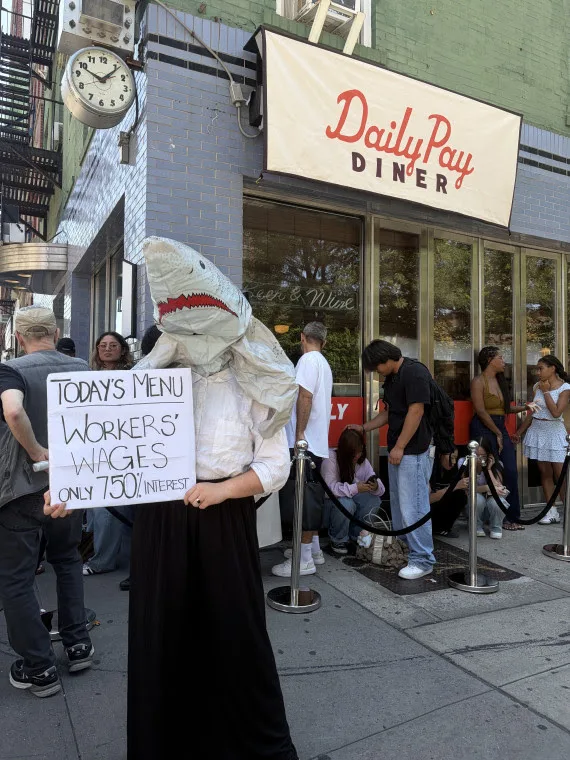
New York, NY – DailyPay’s “DailyPay Diner” publicity stunt got an unexpected visitor Thursday when a costumed “loan shark” crashed the event, carrying a sign advertising “TODAY’S MENU: WORKERS’ WAGES” and confronting the company with damning allegations about its abusive tactics.
In a widely-hyped publicity stunt that went viral, DailyPay booked the 19-year-old Remedy Diner on Houston Street for a pop-up it called the “DailyPay Diner” — a “fully immersive 1930s diner” where patrons could enjoy vintage details and 1930s prices, while learning about the so-called “future of pay.”
The company claims that New Yorkers’ biweekly paychecks are “stuck in the 1930s.” Its solution: smartphone apps that push on-demand, triple-digit payday loans, billed deceptively as “early pay” or “earned wage access (EWA).”
The stunt comes as DailyPay faces a major lawsuit from New York Attorney General Letitia James for allegedly pushing tens of thousands of New Yorkers into high-interest, illegal payday loans — and as a nationwide coalition has launched to combat this Big Tech-backed industry.
An hour into the DailyPay Diner gag, a loan shark appeared, reciting not-so-savory allegations from Attorney General Letitia James’ lawsuit against the company. According to the AG:
- DailyPay extracts over $300 in fees a year per user
- The median advance has an average APR of 400% — sixteen times New York’s legal interest rate cap.
- The most common transaction charges fees equivalent to 750% APR.
- DailyPay’s profit model depends on trapping workers in a cycle of debt:
- Over 55% of workers obtain two or more loans a week.
- More than one in four users take out loans every other day
- The top 10% of users take out 5.7 advances a week – nearly 300 loans a year.
- Total fees extracted from New Yorkers’ paychecks from 2020 to 2024 exceeded $27 million.
“DailyPay disingenuously boasts that it offers ‘the future of pay,’” said Maren Hurley-Matz, New Economy Project’s Equal Justice Works Fellow, who donned the shark costume. “But here’s the truth: extracting money from low-income, working class, Black and brown communities is nothing more than old school loan sharking, no matter how it’s disguised.”
New Economy Project coordinates the New York State Community Equity Agenda, a statewide coalition of community, labor, civil rights, and legal services groups, faith-based and cooperative organizations, and community development financial institutions fighting for economic democracy and racial justice in New York. The coalition challenges predatory industries and fights for the enforcement of New York’s strong usury laws.
While usurious lending is as old as time, the payday loan app industry grew exponentially during the financial instability of the 2020 pandemic and has continued to exploit workers amidst a nationwide affordability crisis. Aggressively marketed online and in workplace breakrooms, EWA companies like DailyPay, EarnIn, MoneyLion, Dave, and Brigit peddle high-cost payday loans through phone apps, with effective annual percentage rates exceeding 330 percent on average.
Workers take out small-dollar advances and are then hit with a cascade of deceptive fees — from “tips” and subscription charges to expedited transfer fees — that leave them short on payday and trigger repeat borrowing, as well as bank account overdraft fees and other financial harm. New Economy Project estimates that the industry has siphoned over $700,000,000 from New Yorkers’ wages since 2019.
EWA companies falsely claim their products aren’t loans so they can avoid laws that limit interest rates and fees. In reality, they advance cash and then collect it back — plus steep fees — directly from workers’ bank accounts or paychecks on payday. Fourteen federal courts have already rejected these companies’ attempts at circumvention, finding that EWA advances are loans regardless of how they’re labeled.
The NYS Community Equity Agenda is fighting for the passage of the Stop Taking Our Pay (STOP) Act (S8939/A9644) to rein in predatory payday loan apps. It’s also calling on state leaders to address root causes of income insecurity, by ensuring all workers earn a true living wage, expanding responsible lending in historically redlined communities of color, and addressing the deepening affordability crisis.