FOR IMMEDIATE RELEASE: May 6, 2025
Contact: Andy Morrison, andy@neweconomynyc.org
Amid Federal Disinvestment and Regulatory Rollbacks, New York Coalition Calls for Public Banks to Spur Local Investment
Advocates from Across New York State Rally at the Capitol for Passage of Bank of Rochester Act and to Advance Public Banking Statewide
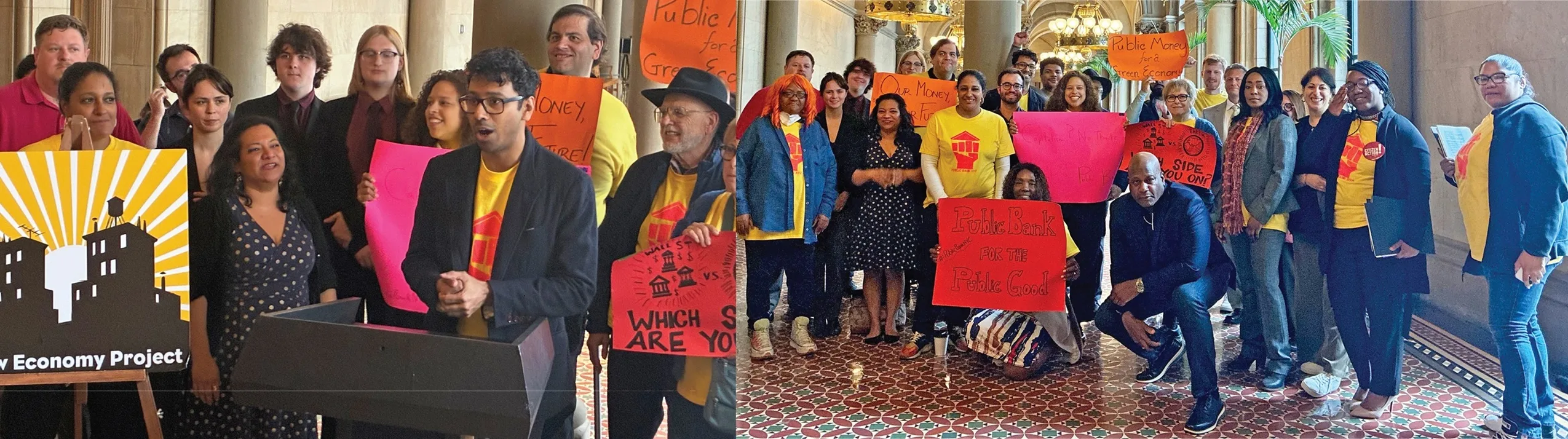
Albany, NY – On Tuesday, community groups, labor unions, credit unions and elected officials from across the state rallied at the New York State Capitol to demand legislative action on public banking. Advocates urged lawmakers to pass the Bank of Rochester Act and lay groundwork for public banks statewide—to invest public dollars in deeply and permanently affordable housing, climate infrastructure, small and worker-owned businesses, and other community wealth-building initiatives.
The action comes as the federal government slashes funding for vital health, education, and housing programs, while dismantling critical financial regulations and watchdog agencies like the Consumer Financial Protection Bureau. These developments threaten to embolden financial predators and exacerbate inequality throughout New York.
Public banks are financial institutions created by local governments and chartered to serve the public interest. Speakers from New Economy Project and several broad-based coalitions—including the NYS Community Equity Agenda, Rochester Public Banking Coalition, and Public Bank NYC—highlighted how public banks can help municipalities protect public funds, strengthen local economies, and partner with responsible lenders to reinvest billions in neighborhoods long excluded and exploited by Wall Street banks.
The groundbreaking Bank of Rochester Act (S1708-A/A6409A), which was approved by the Assembly Banks Committee last year, would establish a local investment vehicle to leverage the city’s public dollars for the public good—in partnership with local banks, credit unions, and community lenders already rooted in local neighborhoods.
QUOTES:
“As Washington continues to roll back financial protections and disinvest in working communities, New York must step up. Public banking is a tool of economic justice—empowering municipalities to invest in affordable housing, green infrastructure, and small businesses,” said NYS Senator James Sanders Jr. “I’m proud to lead the charge for the New York Public Banking Act, and I urge my colleagues and the Governor to make this the year we give our communities the power to build for themselves.”
“The Bank of Rochester Act underscores that local governments can best serve their communities by providing direct economic investment to areas the community most needs,” said Assembly Member Harry B. Bronson. “Rochester is one of the most underserved cities in New York State, and this initiative is a powerful tool for establishing a more collaborative, responsive, and equitable municipal funding process that partners with existing financial institutions and credit unions to drive local investment and community driven economic development.”
“As the federal government continues to target New York with draconian policy reversals, it’s time to embrace public banks as a way to empower local governments to better leverage local resources to support affordable housing, small business development, green infrastructure, and more,” said NYS Senator John Liu. “The New York Public Banking Act and Rochester Act will focus investment directly in New York’s neighborhoods and channel financing to serve real public needs, not just private interests.”
Our communities thrive when we invest in them directly,” said NYS Senator Lea Webb. “Public banking is a powerful tool that can keep public dollars circulating locally—supporting affordable housing, small businesses, and the infrastructure our neighborhoods need. It’s time New York embraced public banking to build a more inclusive and resilient economy.”
“As Chair of the Subcommittee on Banking in Underserved Communities, I’ve seen firsthand how unbanked areas like Assembly District 31 and Southeast Queens function. In neighborhoods like Arverne and Rosedale, the loss of local banks forces Black and Brown families to travel far for basic services or fall victim to predatory lending, such as paying higher fees at check-cashing spots and pawn shops,” said Assemblymember Khaleel Anderson. “A public bank would support local small businesses, MWBEs, and worker co-ops—generating over 70,000 local jobs and building economic power in marginalized communities. It will also fund 17,855 affordable housing units in NYC. Let us acknowledge public banking will put people over profit and uplift those communities in need.”
“Amid federal disinvestment and regulatory rollbacks from the current administration, the need for a public bank is more important than ever,” said Assembly Member Harvey Epstein. “A public bank gives New Yorkers the voice they deserve, placing the money where it is publicly accountable and utilized for investment in New York priorities like affordable housing, clean energy initiatives, fair banking services and eliminating the racial wealth gap. This has the potential to transform our banking system by making it more equitable, accountable and profitable for New York. We don’t have time to waste in protecting New Yorkers.”
“Private banks exist to put capital towards the purpose of making profits,” said Assembly Member Sarahana Shrestha. “If we want to leverage the function of money as a public good, as something that helps us invest in affordable homes, low-cost energy, and stable roads and bridges, we must create a system of public banking. As someone who represents 21 local governments, including 2 county governments, in the Mid-Hudson Valley, I know firsthand how much better our localities would be able to serve our communities if they were authorized to form and control public banks. The state has the power to make this possible, and we should act on it now.”
“This legislation will enable municipalities like Rochester to put its money back into the community, where it can support local economic development — instead of with private banks, where the profit goes off to other entities,” said Assembly Member MaryJane Shimsky. “This used to be done more widely in our country and our communities were stronger for it. We should get back to having a public bank option throughout the State, so that more of our public funds can be directed to the public’s benefit.”
“Federal budget cuts and regulatory rollbacks are a major threat to New Yorkers across the state—and underscore the urgent need for public banking,” said Tousif Ahsan of New Economy Project, which coordinates the Public Bank NYC and New York State Community Equity Agenda coalitions. “Through public banks, local governments can responsibly steward public funds—partnering with community-based financial institutions to close critical funding gaps and build wealth in low-income and Black and brown neighborhoods.”
“We polled New Yorkers about their support for public banking and the results are clear,” said David R. Jones, President and CEO of the Community Service Society of New York. “A majority of New Yorkers support public banking legislation and support is highest among those disproportionately harmed by large Wall Street banks. The New York Public Banking Act would finally give local governments the tools they need to divest from these institutions and expand banking access to those who’ve been excluded for far too long.”
“Rochester urgently needs more investment,” said Dan Apfel, COO at Genesee Co-op Federal Credit Union. “A public bank in Rochester will be a vital partner to local lenders like us. Small and mid-sized businesses will benefit at a time when costs are increasing dramatically.”
“Our credit union has a strong track record of serving low income and immigrant communities, over decades,” said Linda Levy of the Lower East Side People’s Federal Credit Union. “By partnering with—and investing in—CDFIs like ours, a public bank will increase our capacity to serve even more New Yorkers and to provide affordable and equitable financial services to communities long exploited by big banks.”
“In the face of uncertainty due to tariffs and the rollback of federal programs that support entrepreneurs, we must support institutions that uplift our local small businesses,” said Lindsey Vigoda, New York Director of Small Business Majority. “Since 2008, we’ve seen low approval ratings for small business loans from big banks but higher approval ratings from CDFIs, community banks and credit unions. Our public dollars should be used to uplift the heart of our communities — our small business storefronts and local entrepreneurs. Supporting the creation of public banking is one way New York can realize that goal and invest in our communities and businesses.”
Public banking is a cost effective and creative solution providing communities with the capacity to promote their economic development in a socially just and equitable manner,” said David Sprintzen of the Ethical Humanist Society of Long Island.
“It’s outrageous that we continue to allow these private big banks that exploit our communities to hold our public dollars. A well functioning public bank is vital for the economic prosperity of our region,” said Nada Khader of WESPAC. “We need a public banking institution that serves our community’s needs and that uses our public monies to invest in affordable housing, renewable energy and infrastructure development while also moving us towards racial equity and living wages.”
“Tenants face daily horrors from bad-acting landlords, like collapsing ceilings, rat infestations, and construction dust so thick they feel sick—and this is funded by banks that pretend they don’t know how their profits are being made,” said Jodie Leidecker, Cooper Square Committee lead organizer. “It’s time for a public bank that will create affordable housing that benefits and doesn’t harm the community.”
“Recent cuts to consumer protection agencies and environmental regulation rollbacks underscore the urgency of bringing public banking in New York,” said Kyle Giller, staff attorney at the New York Public Interest Research Group (NYPIRG). “Enacting public banking legislation will enable our cities and counties to divest our tax dollars from Wall Street banks and create a publicly accountable financial institution that can invest in community needs and public goods. A public bank will allow our communities to finally make the bold investments we need to address racial inequities, expand affordable financial services like credit unions, and invest in climate infrastructure.”
“New York City deserves financial self-determination. A public bank means we can invest our own money back into our neighborhoods—for affordable housing, small businesses, and the infrastructure we actually need,” said B. Peters, East Harlem El Barrio Community Land Trust Community Land Trust Manager.
“For 250 years, we’ve been keeping our public money in the hands of private banks that use it to invest in whatever enriches them the most—wars, weapons, big tech, oil, pharmaceuticals, etc.,” said Memo Salazar, co-chair of the Western Queens Community Land Trust. “Yet our tax dollars could be stored in healthier ways. A public bank could expand loans for all sorts of economy-boosting initiatives: small businesses, people’s education, home purchases, and the construction of affordable apartment buildings. Especially now, as our federal government continues to gut its funding streams, the shift towards public banking is a crucial step for survival.”
“New York communities need public banking legislation. Municipally chartered public banks can fill the void created by private banking institutions in underbanked and historically redlined communities of color, which have left people and whole neighborhoods vulnerable to predatory lending,” said Christie Peale, Executive Director of the Center for NYC Neighborhoods. “Public banking can also provide critical capital to fuel a range of affordable solutions for working and middle-class homeowners, including home upgrades to future-proof homes through decarbonization and towards climate resilience.”
###