For Immediate Release: April 6, 2026
Contact: Andy Morrison, New Economy Project, andy@neweconomyproject.org, 212-680-5100 x210
COALITION PRESSES ALBANY TO PASS THE STOP ACT AND END PREDATORY FINTECH PAYDAY LENDING THAT FUELS RACIAL WEALTH EXTRACTION AND NEW YORK’S AFFORDABILITY CRISIS
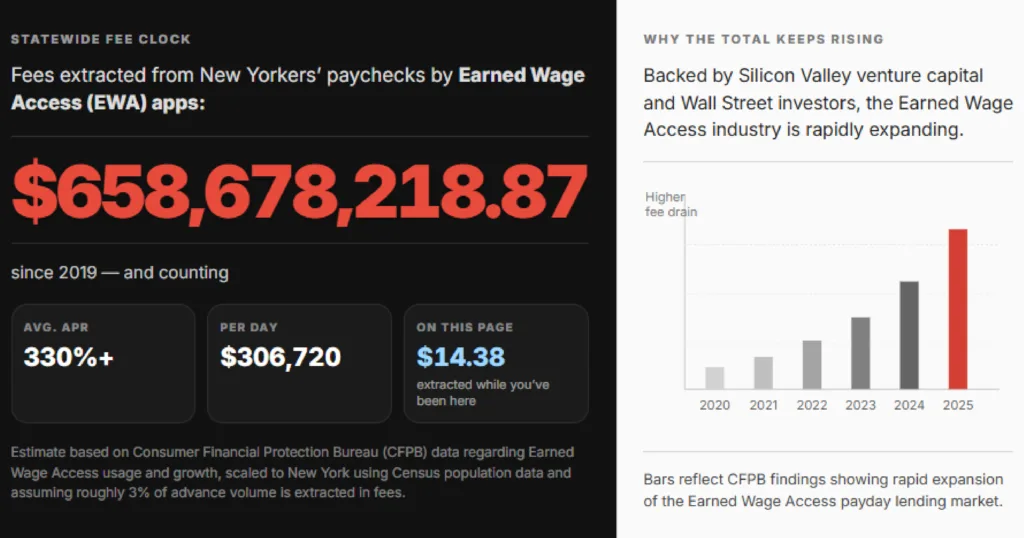
New York, NY – New Economy Project today released a new interactive tool revealing the massive and growing stream of fees that so-called “earned wage access” (EWA) apps are extracting from New Yorkers’ paychecks—exacerbating the state’s affordability crisis and deepening racial wealth inequality.
The group’s “Fintech Paycheck Extraction Clock” tracks, in real time, the total fees siphoned from low-wage workers and communities of color by deceptive EWA smartphone apps, beginning in 2019. The tool shows how these predatory fees accumulate statewide and across regions:
| REGION | EWA FEE DRAIN* |
| New York City | $285 million |
| Long Island | $97 million |
| Hudson Valley | $72 million |
| Buffalo/Niagara MSA | $38 million |
| Rochester MSA | $35 million |
| Statewide | $659 million |
*Figures as of April 6, 2026
“No New Yorker should have to pay to get paid. Yet across the state, Big Tech payday lenders are siphoning hundreds of millions of dollars from workers’ paychecks, exacerbating racial and economic inequality,” said Andy Morrison, Associate Director of New Economy Project. “If New York lawmakers are serious about tackling the affordability crisis, they must act now to shut down illegal payday lending disguised as ‘cash advance’ apps that extract massive wealth from low-wage workers and communities of color, by passing the Stop Taking Our Pay Act.”
Despite marketing their loans as “no-interest” cash advances, EWA apps operate like traditional payday lenders, driving repeat use while charging workers fees and “tips” that translate into triple-digit annual interest rates. One common loan made to New Yorkers carries an effective interest rate above 750% APR, according to NYS Attorney General Letitia James. James is currently suing two major payday lending apps, DailyPay and MoneyLion, for allegedly pushing tens of thousands of New Yorkers into short-term, high-interest, illegal payday loans.
“Their advertisements are misleading. They have videos of people in the supermarket being like, ‘oh shoot! My account is empty. Let me see….oh great! I just got fifty dollars!’ But to get fifty dollars I had to tell them my whole life, and then they took the $50 back right away,” said Maurice, a Brooklyn mom who has used Brigit and EarnIn. “I also felt obligated to tip, maybe because I’m asking to borrow money. The way the app puts it, you do feel obligated. They make loans, and for them to say they’re not loans is very misleading. They need to be transparent about what they are.”
Studies show that EWA apps further erode borrowers’ financial instability. Of NY users who experience overdraft, 68% experience increased overdrafts after their initial advance. Moreover, payday loan apps perpetuate the legacy of predatory racial wealth extraction, with Black and Latino workers almost 60 percent more likely to use payday loan apps than white workers.
EWA Payday Lending Facts
- Using manipulative behavior techniques, tip-based apps successfully coerce 73 percent of borrowers to tip.
- Fees and tips equate to average interest rates of about 383 percent APR for each payday loan app transaction.
- 75% of customers reborrow on the same day or the day after repaying a prior loan.
- On average, users’ borrowing frequency rises from two to four loans per month in the first year of usage.
- There is a high incidence of loan stacking, with multiple payday app lenders making loans against the same paycheck; in New York, more than 50 percent of users borrow from more than one app at a time in the same month.
The release of the tool comes as fintech payday lenders expand rapidly across the country while lobbying aggressively to exempt themselves from state lending laws and interest rate caps. The Consumer Financial Protection Bureau (CFPB) estimates that in 2022, roughly 10 million workers used EWA loans to borrow $31.9 billion of their own wages. The industry was valued at $7.1 billion in 2025 and is projected to grow to a value of $52 billion by 2034, according to market data.
New York Community groups, community development credit unions, and impacted New Yorkers in the NYS Community Equity Agenda coalition are fighting to oppose federal and state-level industry-backed bills. They’re urging state legislators to pass the Stop Taking Our Pay (STOP) Act (S8939/A9644) sponsored by State Senator Samra Brouk of Rochester and Assemblymember Steven Raga of Queens. The STOP Act would crack down on EWA companies by clarifying and reaffirming that EWA advances are loans and that fees count toward interest under New York’s existing usury laws, which cap rates at 25%.
Groups are also calling on state leaders to proactively support financial justice for low-wage New Yorkers by enacting a living wage, bringing public banking to New York, and increasing investment in community development credit unions through the state’s Community Development Financial Institutions (CDFI) Fund.
“At my last job, my employer gave us pamphlets with information about Zayzoon and presented the app as a benefit. We were all underpaid, and I heard other people at the company were using the apps every week,” said Stephanie, a 45-year-old Brooklynite who briefly used Zayzoon and Wagestream. “These apps obviously make loans. To say they aren’t making loans definitely feels deceptive. I wish that instead of always pushing these apps, employers offered information about the benefits of joining community credit unions like Brooklyn Co-Op. On a legislative level, there should be heavier regulation on fees and the repayment structure, and it should be clear that these apps make loans.”
Along with the new tool, the group introduced a take action page and a story bank, featuring videos of New Yorkers sharing their first-hand experience using predatory payday loan apps. Watch Drew from the Bronx and Jose from Queens explain how payday loan apps trapped them in a cycle, and hear their perspectives on what lawmakers should do to protect New Yorkers from predation.
A poll released in January by the Community Service Society found that 88 percent of New Yorkers support cracking down on predatory EWA payday loan apps.