Contacts: Abby Savitch-Lew, New Economy Project, abby@neweconomyproject.org; Patricia Santana, Office of Council Member Sandy Nurse, PSantana@council.nyc.gov
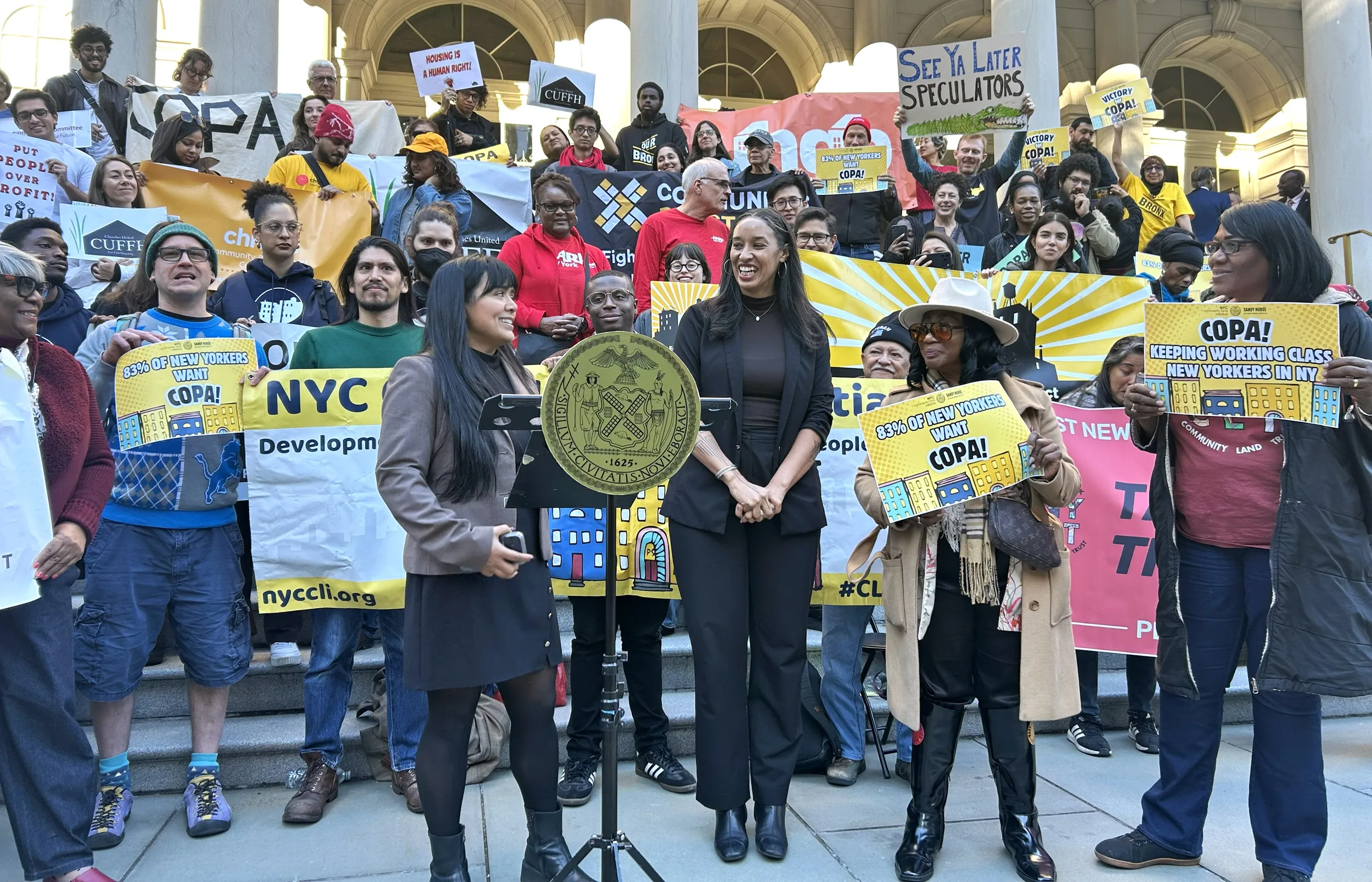
COPA will help keep working-class New Yorkers in NYC, bring thousands of homes into tenant and community ownership, community groups and electeds say at City Hall victory rally
NEW YORK, NY — Amid a deepening housing crisis, the New York City Council today passed the Community Opportunity to Purchase Act (Intro 905-A), or COPA—a landmark piece of legislation designed to stabilize and expand the supply of permanently affordable, community-controlled homes. The bill, championed by lead sponsor Council Member Sandy Nurse and a coalition of over 200+ community, tenant, and affordable housing groups, advanced through the Council with 38 votes in support.
The bill now goes to the desk of Mayor Zohran Mamdani, a strong supporter of COPA who named it as one of two legislative priorities in his 2026 housing plan. Last year, a prior version of the bill advanced through the Council but was vetoed at the eleventh hour by then-mayor Eric Adams.
COPA gives qualified buyers, including community land trusts (CLTs) and other vetted nonprofits and joint ventures, a first opportunity to purchase certain multifamily buildings when they are up for sale. These include multifamily buildings with four or more units that have sustained physical distress and those with affordability restrictions governed by HPD regulatory agreements.
“The Community Opportunity to Purchase Act (COPA) is an example of what happens when tenants, organizations and progressive legislators not only give the real estate lobby a run for its money, but win. After six years, multiple Mayors, and a veto, we finally passed COPA,” said Council Member Sandy Nurse. “COPA will keep thousands of struggling New Yorkers in their homes, preserve neighborhood affordability, and bring more at-risk housing into community control. It’s another tool now at our disposal to fight back against our city’s affordable housing crisis, help end displacement and give working families a chance to stay in the city we love.”
Today’s legislative victory follows a six-year campaign led by the NYC Community Land Initiative (NYCCLI)—a citywide coalition of CLTs and social justice organizations—to expand pathways for community ownership of land and housing. COPA received broad support from more than 200 community and tenant groups, affordable housing developers, and community development financial institutions, as well as from dozens of State elected officials.
COPA is a strategic, proven tool to preserve affordable housing in Black and brown communities. San Francisco’s COPA, enacted in 2019, has already preserved over 430 homes and kept more than 1,000 residents housed—demonstrating that this model succeeds in fast-moving, high-cost markets. The policy has quickly become a central component of San Francisco’s housing preservation and rehabilitation strategy, used in nearly three-quarters of city-funded projects.
New York City’s COPA targets a strategic subset of buildings where tenants are at risk of displacement. COPA will apply to multifamily buildings that are in a housing enforcement program for one year, have an average of three or more hazardous or immediately hazardous violations per unit, or have affordability restrictions managed by the city’s Dept. of Housing Preservation and Development. The law exempts 1-3 family homes, four- and five-unit owner-occupied buildings, and transfers between family members, among other exclusions.
The legislation also creates clear, predictable timelines that make preservation purchases possible and bring stability to a volatile part of the housing market under extreme speculative pressure. A detailed breakdown can be found on this fact sheet.
QUOTES
“The City Council’s approval of the Community Opportunity to Purchase Act is a transformative victory for housing justice—won through years of organizing by community land trusts, tenants, and community groups across the five boroughs. Together, we overcame the real estate lobby and secured groundbreaking legislation that will help take land and housing off the speculative market and bring it into permanently affordable community ownership,” said Deyanira Del Rio, Executive Director of New Economy Project, which coordinates NYCCLI. “We thank Council Member Sandy Nurse for championing COPA, and we commend Speaker Menin and the NYC Council for taking bold action to address our city’s affordability crisis by passing this landmark bill.”
“New York City is facing a housing crisis—not only because we lack affordable homes, but because too many of the homes we already have are deteriorating under cycles of speculation, disinvestment, and neglect,” said New York City Council Member Pierina Sanchez, Chair of the Committee on Housing and Buildings. “The Community Opportunity to Purchase Act gives us a powerful new tool to interrupt those cycles at the point of sale, giving mission-driven nonprofits a fair chance to acquire distressed and affordable buildings and put them on a path toward long-term stability. I am proud to have supported COPA’s evolution as Housing Chair, shepherding it through multiple hearings. I am grateful to Council Member Sandy Nurse for the persistence and work it took to get COPA across the finish line, and to the COPA Coalition, led by New Economy Project and NYCLI with tenant organizers across our city, including Our Bronx, who made this victory possible.”
“The passage of COPA is a huge victory for the Bronx and for communities fighting to stay in their homes,” said Sandra Lobo, Executive Director of Our Bronx. “Our Bronx and the Bronx Community Land Trust are working with residents across the borough to advance permanently affordable housing, community ownership, and long-term stewardship rooted in local leadership. COPA will help level the playing field, giving nonprofits and community land trusts a fairer opportunity to purchase eligible buildings and keep them in community hands. We commend the City Council for passing this legislation and taking action to help New Yorkers remain in the neighborhoods they’ve helped build.”
“We are facing a historic housing affordability crisis,” said Council Member Tiffany Caban. “COPA is a vital tool to put at-risk buildings back in the hands of community organizations to preserve them. This is an important step to making sure that every New Yorker has an affordable, healthy, and safe place to live in our city.”
“We are thrilled that the NYC Council has passed COPA. We know from first hand experience how transformative this legislation will be for tenants and community land trusts,” said Boris Santos, President of the East New York Community Land Trust. “The ENYCLT put in the work to organize residents and donors to become the first CLT to directly purchase our first building from investors, who had neglected it for years. Through COPA, the city can support acquisitions of buildings like these—over-leveraged rent stabilized properties—to ensure that these buildings are kept permanently affordable and under tenant and community control. These acquisitions are proven to work and directly improve New Yorkers’ lives.”
“I am deeply proud to stand alongside Council Member Nurse as she finally passes COPA today. In order to address our housing crisis, we must build new opportunities for deeply affordable housing. The opportunities that COPA creates for community-controlled housing is invaluable, and we must continue to build pathways for expanding access to permanently affordable housing in our city. This is a victory for tenant justice,” said Council Member Alexa Avilés.
“The Community Opportunity to Purchase Act (COPA) passing is a huge leap forward for tenants and creating a new pipeline of social housing,” said Arielle Hersh, Director of Policy at UHAB. “COPA turns crisis into opportunity; we can remove properties from the speculative market and stabilize them as the high-quality, safe, affordable homes New Yorkers deserve. We look forward to using COPA to enable tenants to take control of their housing and bring more resident control to New York City.”
“I am beyond thrilled that we have finally passed COPA and it will become law,” said Council Member Shahana Hanif. “As former Co-Chair of the Council’s Progressive Caucus, I’m proud to have worked alongside Chair Nurse for years on this critical measure. Housing affordability is the number one issue I hear about from my constituents. Trusted community organizations like the Fifth Avenue Committee are ready to create and preserve deeply affordable homes, yet too often they’re pushed aside while profit-driven developers take over, driving displacement. COPA will give these organizations a fair opportunity to protect affordable housing and put people before profit.”
“Cooper Square Committee is so proud of New York City for passing COPA. We want to continue our rich legacy of creating community land trusts,” said Illapa Sairitupac, a Housing Organizer at Cooper Square Committee. “Our organization frequently works with tenants whose lives are upended when their building is sold to a neglectful corporate landlord. COPA will give tenants the ability to facilitate needed improvements and preserve the affordability of their buildings in perpetuity. Such policies have already proven successful in places like San Francisco, and we’re confident New York will use COPA to great effect, to protect tenants from displacement and stabilize our housing stock.”
“What a transformative moment for New York City. We often talk about creative solutions to the challenges New Yorkers face right at their front doors, and COPA is exactly that. This landmark legislation is about preserving affordable housing. It is about combating displacement, protecting the legacy of working-class families. That is how we build a New York City where the very people who built our communities have a seat at the table in one of the most competitive housing markets in the world,” said Council Member Shanel Thomas-Henry.
“A huge congratulations to the community land trust movement and to the City Council for passing COPA,” said Valerio Orselli, Project Director of This Land Is Ours CLT. “Two years ago, this Land Is Ours CLT participated in a successful bid to develop 500 affordable homes on the site of a shuttered Catholic church. Among other projects, we are currently working with the tenants of 438-440 West 45th Street and 331 East 14th Street and a Preservation Purchaser to acquire homes previously owned by slumlord Ohebshalom, and we’re at a critical stage in our negotiations with the current owner. COPA will make challenging acquisition processes like these far more efficient.”
“The Community Opportunity to Purchase Act is a critical tool to protect vulnerable tenants from eviction and prevent at-risk multi-family buildings from being bought up by predatory real estate investors. Instead, qualified community-based non-profits will be able to expand the supply of much-needed permanently affordable housing and keep residents in their homes. I’m proud to support Council Member Nurse’s urgent legislation that is smartly modeled after successful programs in other U.S. cities,” said Council Member Lincoln Restler.
“Throughout the history of the Bronx, nonprofit and community-based developers have saved, stabilized, and restored neighborhoods in every corner of our borough,” said Council Member Justin E. Sanchez, Co-Chair of Council’s Bronx Delegation. “Each of their investments was grounded in their understanding and belief in the community. COPA will continue to empower and protect nonprofit developers, and allow them to do their critical community-building work. In a time where private equity firms are buying out housing stock all over the U.S. and gentrification is running rampant here in New York, we need to use our power as legislators to allow nonprofit developers to keep thriving and stand strong as pillars in our communities.”
“I am deeply moved by the passage of COPA. Having lived in the same apartment in Hell’s Kitchen for more than forty years and having witnessed firsthand the devastating effects the action and inaction of a predatory landlord has had on my fellow tenants and neighbors, I believe it is high time that the city allow the community to decide for itself what is in its own best interest,” said Nicholas Latimer, Tenants’ Association leader at 438/440 W. 45th Street, apartment buildings formerly owned by Daniel Ohebshalom, a NYC ‘worst landlord’ as declared by the NYC Public Advocate’s Office. “It does not take an army of outside developers to shape the future of our shared spaces. It takes a village. And the village is ready, willing, and more than able to do the necessary work.”
“Too many properties across my district are owned by corporate entities that don’t see the humans living in their buildings — they treat homes as assets and leave tenants in a cycle of neglect,” said Council Member Jennifer Gutiérrez. “COPA, a proven solution in other big cities like San Francisco, creates a legitimate pathway for permanently affordable, community-controlled housing and giving tenants and mission-driven nonprofits, including the strong community-based organizations already doing this work, the chance to step in before conditions collapse further.”
“COPA’s passage is a true win for Queens,” said Jenny Dubnau, Co-Chair of the Western Queens CLT. “COPA will help Western Queens CLT transform existing housing in Queens so it’s permanently affordable and tenant-controlled. Next up, we must pass another key component of the Community Land Act (CLA) package: Public Land for Public Good Act, which would require NYC to prioritize CLTs and nonprofit developers when disposing of City-owned land. The work is just beginning!”
“As a former tenants’ rights attorney, I saw very clearly what it looks like when our city prioritizes landlords over working New Yorkers and families,” said Council Member Shekar Krishnan. “I’m thankful that COPA is being passed by our City Council, a groundbreaking piece of legislation that protects affordable housing and supports the nonprofits that make our city affordable.”
“We thank the City Council for their perseverance and passing this legislation and giving communities a fighting chance to stay rooted,” said Michelle de la Uz, Executive Director of the Fifth Avenue Committee. “The Community Opportunity to Purchase Act is a vital tool to combat displacement and preserve affordability in our neighborhoods. For decades, the Fifth Avenue Committee has worked to ensure that low- and moderate-income New Yorkers can remain in the communities they helped build. COPA empowers mission-driven nonprofits like ours to compete with speculative buyers and ensure housing remains affordable for community residents for generations to come.”
“Today is a historic day as we pass COPA in the New York City Council, standing with tenants fighting to stay in their communities,” said Council Member Harvey Epstein. “COPA gives tenants and mission-driven nonprofits the first opportunity to buy certain buildings when they go up for sale, helping preserve affordability and prevent displacement. Thank you to Speaker Menin, Council Member Nurse, and all of my colleagues and advocates who made today possible.”
“We commend the City Council for passing this landmark legislation. Too many New Yorkers spend so much on rent that saving for a home of their own feels impossible,” said Christie Peale, CEO and Executive Director of the Center for NYC Neighborhoods. “COPA will change that by creating new affordable pathways to homeownership so that tenants have a chance to work with community based non-profits to buy their apartments from their landlords. We thank Speaker Menin, Council Member Sandy Nurse and the City Council for helping protect affordable homes and expand opportunities for ownership.”
“This is what it looks like when communities organize, persist, and win. As locals, we know the future of New York City is not only about infrastructure. It is also about whether the communities that actually built this city, neighborhood by neighborhood, can remain here and have a voice in its future,” said Malik Sanders, Executive Director of ReAL Edgemere Community Land Trust. “The passage of COPA is a major victory for tenants and mission-driven organizations fighting to keep our families rooted here and bring homes into long-term community stewardship. Simply put, we cannot continue losing our homes, families, and neighborhoods to speculation. We thank Council Member Sandy Nurse, the City Council, and the broad coalition that fought to make this victory possible.”
“We commend the NYC Council for passing COPA, a critical bill that we staunchly support,” said Benjamin Warnke, principal of Alembic Community Development. “COPA gives responsible developers and community organizations a new tool to stabilize and preserve truly affordable housing. It will foster partnerships between qualified, mission-driven nonprofits and for-profit developers to efficiently exercise COPA rights. Alembic and CLOTH have participated in joint ventures for years to complete new construction and housing preservation projects in Washington Heights, Hamilton Heights, and Inwood. Our experience points to how these partnerships can fuel COPA’s success, and we are ready to ensure COPA’s effective implementation from day one.”
“We are elated to hear the NYC Council passed COPA today,” said Yvonne Stennett, Executive Director of Community League of the Heights (CLOTH). “For more than seven decades, CLOTH has worked to preserve and develop the housing stock of the Washington Heights neighborhood for low-income families. Giving Community Development Organizations like ours a right of first offer and right of refusal when privately owned buildings are placed on the market for sale will yield enormous benefits for communities across New York City. It will help curb speculation and the ill-desired effect of displacement that often accompanies it—particularly in rapidly gentrifying neighborhoods. It will also enhance the viability of HPD’s Neighborhood Pillars Program, which will in turn help stabilize communities by ensuring that properties are rehabilitated and made affordable.”
“For decades, the real estate lobby and its corporate benefactors have worsened the housing crisis, denying working New Yorkers much-needed affordable housing,” said Council Member Chi Ossé. “The Community Opportunity to Purchase Act brings our city one step closer to ensuring housing remains permanently affordable and represents tenants’ interests, and not real estate profits. Today’s housing crisis demands a whole-of-government approach, and I’m proud to support the long overdue passage of this legislation so we can gain another tool to confront this crisis.”
“We thank the City Council for passing COPA,” said Will Depoo, Senior Campaign Organizer at the Association for Neighborhood and Housing Development. “As we continue to face a housing and homelessness crisis, we must build and preserve affordable housing for those who need it most. COPA provides our communities with a key tool to fight speculation, move distressed buildings into the hands of responsible community stewards, and ensure that public resources go where they’re most needed.”
“This has been a long time coming. For years, communities across this city have demanded a fair shot at buying property in their own neighborhoods before speculators and private developers price them out,” said Council Member Julie Won. “COPA gives community land trusts, nonprofit developers, and trusted local partners a seat at the negotiating table before they’re shut out of the market. This is about giving communities a real chance to shape their neighborhoods and keep them affordable for the people who call them home.”
“COPA will be a game-changer for neighborhoods in the South Bronx that face severe displacement pressures, such as Mott Haven,” said Matthew Shore, Director of Planning & Development at South Bronx Unite. “Mott Haven ranks amongst the highest in the city for rent burden, evictions, and housing code violations. At the same time, new housing units produced at or above 80% AMI in our community district were double that of units at or below 80% AMI. We know that CLTs and nonprofit developers have a better track record of building and preserving affordable housing development than for-profit developers. We’re overjoyed that we now have COPA to preserve our working-class communities and address our city’s affordability crisis.”
“I started organizing with my neighbors because my building was in disrepair with an unresponsive landlord. For tenants like me, COPA represents an opportunity for a better future and a greater voice in what happens to their homes,” said Ann Maitin, a member of CASA (Community Action for Safe Apartments) and leader of a tenants association in the Bronx. “There is more work ahead. The SAFER Homes Act is another important effort to address severely neglected buildings and hold irresponsible landlords accountable. A safe and dignified home should be a basic expectation, not a privilege.”
“Today is a day for celebration. COPA will let residents like us stay in our homes and keep our neighborhoods from becoming playgrounds for the wealthy,” said John Leyva, a tenant leader at 63 Tiffany Place. “The tenants in this city are at a disadvantage, fighting against millionaires, billionaires, and increasingly, private equity. It’s a David vs. Goliath fight. With the passage of COPA in the City Council, we are finally leveling the playing field.”